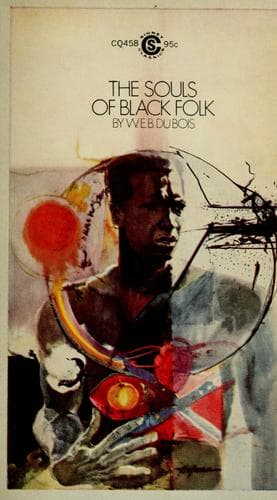
The Souls of Black FolkDu Bois, W. E. B. (William Edward Burghardt)
History
The Souls of Black Folk
Du Bois, W. E. B. (William Edward Burghardt)
African Americans
The function of the Negro college, then, is clear: it must maintain the
standards of popular education, it must seek the social regeneration of
the Negro, and it must help in the solution of problems of race contact
and cooperation. And finally, beyond all this, it must develop men.
Above our modern socialism, and out of the worship of the mass, must
persist and evolve that higher individualism which the centres of
culture protect; there must come a loftier respect for the sovereign
human soul that seeks to know itself and the world about it; that seeks
a freedom for expansion and self-development; that will love and hate
and labor in its own way, untrammeled alike by old and new. Such souls
aforetime have inspired and guided worlds, and if we be not wholly
bewitched by our Rhinegold, they shall again. Herein the longing of
black men must have respect: the rich and bitter depth of their
experience, the unknown treasures of their inner life, the strange
rendings of nature they have seen, may give the world new points of
view and make their loving, living, and doing precious to all human
hearts. And to themselves in these the days that try their souls, the
chance to soar in the dim blue air above the smoke is to their finer
spirits boon and guerdon for what they lose on earth by being black.
I sit with Shakespeare and he winces not. Across the color line I move
arm in arm with Balzac and Dumas, where smiling men and welcoming women
glide in gilded halls. From out the caves of evening that swing between
the strong-limbed earth and the tracery of the stars, I summon
Aristotle and Aurelius and what soul I will, and they come all
graciously with no scorn nor condescension. So, wed with Truth, I dwell
above the Veil. Is this the life you grudge us, O knightly America? Is
this the life you long to change into the dull red hideousness of
Georgia? Are you so afraid lest peering from this high Pisgah, between
Philistine and Amalekite, we sight the Promised Land?
VII.
Of the Black Belt
I am black but comely, O ye daughters of Jerusalem,
As the tents of Kedar, as the curtains of Solomon.
Look not upon me, because I am black,
Because the sun hath looked upon me:
My mother’s children were angry with me;
They made me the keeper of the vineyards;
But mine own vineyard have I not kept.
THE SONG OF SOLOMON.
[Illustration]
Public-domain text, read in full here on John Shaqi.
Reviews
Reviews
No reviews yet
Be the first to share your thoughts on this work.
Elsewhere in the archive
Join the Discussion
Join the discussion
Sign in to leave a comment or review.
Sign InorCreate an account