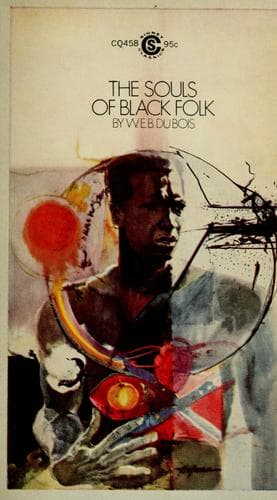
The Souls of Black FolkDu Bois, W. E. B. (William Edward Burghardt)
History
The Souls of Black Folk
Du Bois, W. E. B. (William Edward Burghardt)
African Americans
Out of the North the train thundered, and we woke to see the crimson
soil of Georgia stretching away bare and monotonous right and left.
Here and there lay straggling, unlovely villages, and lean men loafed
leisurely at the depots; then again came the stretch of pines and clay.
Yet we did not nod, nor weary of the scene; for this is historic
ground. Right across our track, three hundred and sixty years ago,
wandered the cavalcade of Hernando de Soto, looking for gold and the
Great Sea; and he and his foot-sore captives disappeared yonder in the
grim forests to the west. Here sits Atlanta, the city of a hundred
hills, with something Western, something Southern, and something quite
its own, in its busy life. Just this side Atlanta is the land of the
Cherokees and to the southwest, not far from where Sam Hose was
crucified, you may stand on a spot which is to-day the centre of the
Negro problem,—the centre of those nine million men who are America’s
dark heritage from slavery and the slave-trade.
Not only is Georgia thus the geographical focus of our Negro
population, but in many other respects, both now and yesterday, the
Negro problems have seemed to be centered in this State. No other State
in the Union can count a million Negroes among its citizens,—a
population as large as the slave population of the whole Union in 1800;
no other State fought so long and strenuously to gather this host of
Africans. Oglethorpe thought slavery against law and gospel; but the
circumstances which gave Georgia its first inhabitants were not
calculated to furnish citizens over-nice in their ideas about rum and
slaves. Despite the prohibitions of the trustees, these Georgians, like
some of their descendants, proceeded to take the law into their own
hands; and so pliant were the judges, and so flagrant the smuggling,
and so earnest were the prayers of Whitefield, that by the middle of
the eighteenth century all restrictions were swept away, and the
slave-trade went merrily on for fifty years and more.
Down in Darien, where the Delegal riots took place some summers ago,
there used to come a strong protest against slavery from the Scotch
Highlanders; and the Moravians of Ebenezer did not like the system. But
not till the Haytian Terror of Toussaint was the trade in men even
checked; while the national statute of 1808 did not suffice to stop it.
How the Africans poured in!—fifty thousand between 1790 and 1810, and
then, from Virginia and from smugglers, two thousand a year for many
years more. So the thirty thousand Negroes of Georgia in 1790 doubled
in a decade,—were over a hundred thousand in 1810, had reached two
hundred thousand in 1820, and half a million at the time of the war.
Thus like a snake the black population writhed upward.
Public-domain text, read in full here on John Shaqi.
Reviews
Reviews
No reviews yet
Be the first to share your thoughts on this work.
Elsewhere in the archive
Join the Discussion
Join the discussion
Sign in to leave a comment or review.
Sign InorCreate an account