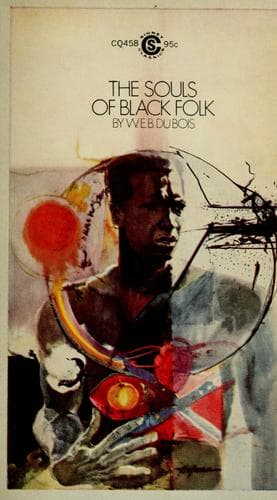
The Souls of Black FolkDu Bois, W. E. B. (William Edward Burghardt)
History
The Souls of Black Folk
Du Bois, W. E. B. (William Edward Burghardt)
African Americans
No wonder that Luke Black, slow, dull, and discouraged, shuffles to our
carriage and talks hopelessly. Why should he strive? Every year finds
him deeper in debt. How strange that Georgia, the world-heralded refuge
of poor debtors, should bind her own to sloth and misfortune as
ruthlessly as ever England did! The poor land groans with its
birth-pains, and brings forth scarcely a hundred pounds of cotton to
the acre, where fifty years ago it yielded eight times as much. Of his
meagre yield the tenant pays from a quarter to a third in rent, and
most of the rest in interest on food and supplies bought on credit.
Twenty years yonder sunken-cheeked, old black man has labored under
that system, and now, turned day-laborer, is supporting his wife and
boarding himself on his wages of a dollar and a half a week, received
only part of the year.
The Bolton convict farm formerly included the neighboring plantation.
Here it was that the convicts were lodged in the great log prison still
standing. A dismal place it still remains, with rows of ugly huts
filled with surly ignorant tenants. “What rent do you pay here?” I
inquired. “I don’t know,—what is it, Sam?” “All we make,” answered Sam.
It is a depressing place,—bare, unshaded, with no charm of past
association, only a memory of forced human toil,—now, then, and before
the war. They are not happy, these black men whom we meet throughout
this region. There is little of the joyous abandon and playfulness
which we are wont to associate with the plantation Negro. At best, the
natural good-nature is edged with complaint or has changed into
sullenness and gloom. And now and then it blazes forth in veiled but
hot anger. I remember one big red-eyed black whom we met by the
roadside. Forty-five years he had labored on this farm, beginning with
nothing, and still having nothing. To be sure, he had given four
children a common-school training, and perhaps if the new fence-law had
not allowed unfenced crops in West Dougherty he might have raised a
little stock and kept ahead. As it is, he is hopelessly in debt,
disappointed, and embittered. He stopped us to inquire after the black
boy in Albany, whom it was said a policeman had shot and killed for
loud talking on the sidewalk. And then he said slowly: “Let a white man
touch me, and he dies; I don’t boast this,—I don’t say it around loud,
or before the children,—but I mean it. I’ve seen them whip my father
and my old mother in them cotton-rows till the blood ran; by—” and we
passed on.
Public-domain text, read in full here on John Shaqi.
Reviews
Reviews
No reviews yet
Be the first to share your thoughts on this work.
Elsewhere in the archive
Join the Discussion
Join the discussion
Sign in to leave a comment or review.
Sign InorCreate an account