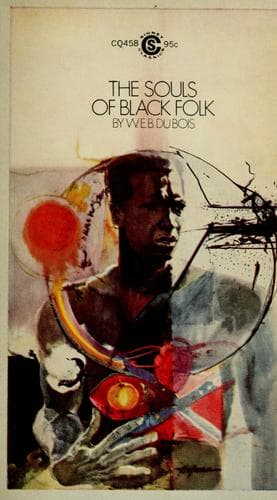
The Souls of Black FolkDu Bois, W. E. B. (William Edward Burghardt)
History
The Souls of Black Folk
Du Bois, W. E. B. (William Edward Burghardt)
African Americans
Two children—a boy and a girl—are hoeing sturdily in the fields on the
farm where Corliss works. He is smooth-faced and brown, and is fencing
up his pigs. He used to run a successful cotton-gin, but the Cotton
Seed Oil Trust has forced the price of ginning so low that he says it
hardly pays him. He points out a stately old house over the way as the
home of “Pa Willis.” We eagerly ride over, for “Pa Willis” was the tall
and powerful black Moses who led the Negroes for a generation, and led
them well. He was a Baptist preacher, and when he died, two thousand
black people followed him to the grave; and now they preach his funeral
sermon each year. His widow lives here,—a weazened, sharp-featured
little woman, who curtsied quaintly as we greeted her. Further on lives
Jack Delson, the most prosperous Negro farmer in the county. It is a
joy to meet him,—a great broad-shouldered, handsome black man,
intelligent and jovial. Six hundred and fifty acres he owns, and has
eleven black tenants. A neat and tidy home nestled in a flower-garden,
and a little store stands beside it.
We pass the Munson place, where a plucky white widow is renting and
struggling; and the eleven hundred acres of the Sennet plantation, with
its Negro overseer. Then the character of the farms begins to change.
Nearly all the lands belong to Russian Jews; the overseers are white,
and the cabins are bare board-houses scattered here and there. The
rents are high, and day-laborers and “contract” hands abound. It is a
keen, hard struggle for living here, and few have time to talk. Tired
with the long ride, we gladly drive into Gillonsville. It is a silent
cluster of farmhouses standing on the crossroads, with one of its
stores closed and the other kept by a Negro preacher. They tell great
tales of busy times at Gillonsville before all the railroads came to
Albany; now it is chiefly a memory. Riding down the street, we stop at
the preacher’s and seat ourselves before the door. It was one of those
scenes one cannot soon forget:—a wide, low, little house, whose
motherly roof reached over and sheltered a snug little porch. There we
sat, after the long hot drive, drinking cool water,—the talkative
little storekeeper who is my daily companion; the silent old black
woman patching pantaloons and saying never a word; the ragged picture
of helpless misfortune who called in just to see the preacher; and
finally the neat matronly preacher’s wife, plump, yellow, and
intelligent. “Own land?” said the wife; “well, only this house.” Then
she added quietly. “We did buy seven hundred acres across up yonder,
and paid for it; but they cheated us out of it. Sells was the owner.”
“Sells!” echoed the ragged misfortune, who was leaning against the
balustrade and listening, “he’s a regular cheat. I worked for him
thirty-seven days this spring, and he paid me in cardboard checks which
were to be cashed at the end of the month. But he never cashed
them,—kept putting me off.
Public-domain text, read in full here on John Shaqi.
Reviews
Reviews
No reviews yet
Be the first to share your thoughts on this work.
Elsewhere in the archive
Join the Discussion
Join the discussion
Sign in to leave a comment or review.
Sign InorCreate an account