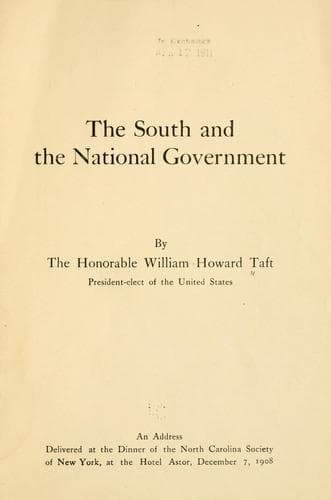
The South and the National GovernmentTaft, William H. (William Howard)
History
The South and the National Government
Taft, William H. (William Howard)
African Americans; Southern States
Again, for a long time succeeding the war, the South continued poor. Its
development was much slower than that of the rest of the country.
Prosperity seemed to be Northern prosperity, not Southern. And, in such
a time, the trials of life of the present only accentuated the greater
trials of the past, and reminiscences of the dreadful sufferings and
privations of the war were present on every hand, and feelings that the
controversy had given rise to, remained with an intensity that hardly
seemed to be dimmed by passing time.
But times change, and men change with them in any community, however
fixed its thoughts or habits, and many circumstances have blessed us
with their influence in this matter.
The growth of the South since 1890 has been marvelous. The manufacturing
capital in 1880 was $250,000,000, in 1890, $650,000,000, in 1900,
$1,150,000,000 and in 1908, $2,100,000,000, while the value of the
manufactures increased from $450,000,000, in 1880 to $900,000,000 in
1890, to $1,450,000,000 in 1900, and to $2,600,000,000, in 1908. The
farm products in 1880 were $660,000,000, in 1890 were $770,000,000, in
1900, $1,270,000,000, in 1908 $2,220,000,000. The exports from the South
in 1880 were $260,000,000, in 1890 $306,000,000, in 1900, $484,000,000,
and in 1908, $648,000,000.
In this marvelous growth the manufactures of the South now exceed the
agricultural products, and thus a complete change has come over the
character of her industries. The South has become rich, and only the
surface of her wealth has been scratched. Her growth has exceeded that
of the rest of the country, and she is now in every way sharing in its
prosperity.
Again, the Democratic party has not preserved inviolate its traditional
doctrines as to state's rights and other issues, and has for the time
adopted new doctrines of possibly doubtful economic truth and wisdom.
Southern men, adhering to the party and the name, find themselves,
through the influence of tradition and the fear of a restoration of
conditions which are now impossible, supporting a platform and candidate
whose political and economic theories they distrust. Under these
conditions there was in the last campaign, and there is to-day
throughout the South, among many of its most intelligent citizens, an
impatience, a nervousness, and a restlessness in voting for one ticket
and rejoicing in the success of another.
Public-domain text, read in full here on John Shaqi.
Reviews
Reviews
No reviews yet
Be the first to share your thoughts on this work.
Join the Discussion
Join the discussion
Sign in to leave a comment or review.
Sign InorCreate an account