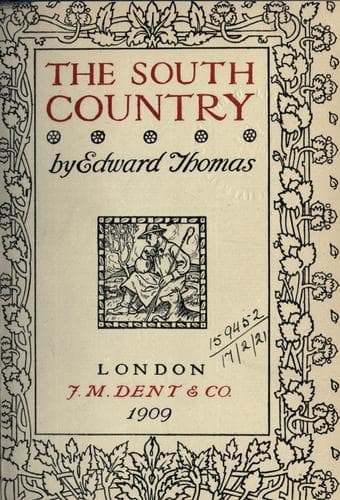
England -- Description and travel; Natural history -- England; Thomas, Edward, 1878-1917 -- Travel -- England
On a natural hillock stands what
appears to be the ruin of an irregularly heaped wall of grey rock,
roughened by dark-grey lichen, built of enormous angular fragments like
the masonry of a giant’s child. Near at hand, bracken, pink stonecrop,
heather and bright gold tormentil soften it; but at a distance it
stands black against the summer sky, touched with the pathos of man’s
handiwork overthrown, yet certainly an accident of Nature. It commands
Cape Cornwall and the harsh sea, and St. Just with its horned church
tower. On every hand lie cromlech, camp, circle, hut and tumulus of
the unwritten years. They are confused and mingled with the natural
litter of a barren land. It is a silent Bedlam of history, a senseless
cemetery or museum, amidst which we walk as animals must do when they
see those valleys full of skeletons where their kind are said to go
punctually to die. There are enough of the dead; they outnumber the
living; and there those trite truths burst with life and drum upon the
tympanum with ambiguous fatal voices. At the end of this many-barrowed
moor, yet not in it, there is a solitary circle of grey stones, where
the cry of the past is less vociferous, less bewildering, than on the
moor itself, but more intense. Nineteen tall, grey stones stand round
a taller, pointed one that is heavily bowed, amidst long grass and
bracken and furze. A track passes close by, but does not enter the
circle; the grass is unbent except by the weight of its bloom. It bears
a name that connects it with the assembling and rivalry of the bards
of Britain. Here, under the sky, they met, leaning upon the stones,
tall, fair men of peace, but half-warriors, whose songs could change
ploughshare into sword. Here they met, and the growth of the grass, the
perfection of the stones (except that one stoops as with age), and the
silence, suggest that since the last bard left it, in robe of blue or
white or green--the colours of sky and cloud and grass upon this fair
day--the circle has been unmolested, and the law obeyed which forbade
any but a bard to enter it. Sky-blue was the colour of a chief bard’s
robe, emblematic of peace and heavenly calm, and of unchangeableness.
White, the colour of the Druid’s dress, was the emblem of light, and of
its correlatives, purity of conduct, wisdom, and piety. Green was the
colour of the youthful ovate’s robe, for it was the emblem of growth.
Their uniformity of colour signified perfect truth. And the inscription
upon the chair of the bards of Beisgawen was, “Nothing is that is not
for ever and ever.” Blue and white and green, peace and light and
growth--“Nothing is that is not for ever and ever”--these things and
the blue sky, the white, cloudy hall of the sun, and the green bough
and grass, hallowed the ancient stones, and clearer than any vision
of tall bards in the morning of the world was the tranquil delight of
being thus “teased out of time” in the presence of this ancientness.
Public-domain text, read in full here on John Shaqi.
Reviews
Reviews
No reviews yet
Be the first to share your thoughts on this work.
Elsewhere in the archive
Join the Discussion
Join the discussion
Sign in to leave a comment or review.
Sign InorCreate an account