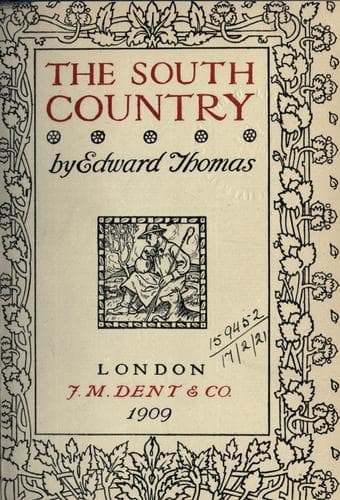
England -- Description and travel; Natural history -- England; Thomas, Edward, 1878-1917 -- Travel -- England
Nowhere is the stateliness or grace or privacy of trees more
conspicuous than about the Cornish towns and farms. The tall
round-topped elms above Padstow, for example, would be natural and
acceptable unconsciously elsewhere; but above those crossing lines of
roof they have an indescribable benevolence. The farmhouses are usually
square, dry and grey, being built of slate with grey-slated roofs
painted by lichen; some are whitewashed; in some, indeed, the stones
are of many greys and blues, with yellowish and reddish tinges, hard,
but warm in the sun and comforting to look at when close to the sea
and some ruinous promontory; few are screened by ivy or climbing rose.
The farm buildings are of the same kind, relieved by yellow straw, the
many hues of hay, the purple bracken stacks, the dark peat. The gates
are coarse and mean, of iron or of cheap or rough wood, lightly made,
patched, held together by string, and owing their only charm to the
chance use of the curved ribs of ships as gate-posts. But to many of
the buildings sycamore and ash and apple trees bent above tall grass
lend their beauty of line, of mass, of colour, of shade, of sound and
of many motions. I can never forget the rows of ash trees, the breezy
sycamores and the tamarisks by ancient Harlyn, with its barrows on the
hill, its ruins of chapel and church among rushes and poppies, its
little oak wood by the sandy river mouth where the men of old time
buried their dead, the poppied corn, the white gulls and their black
shadows wheeling over sunny turf. The file of lean woods seen between
Perranporth and St. Agnes inland. The sycamores above the farm near
Towan cross where the road dips and the deep furrow of a little valley
winds, with hay upon its slopes, out to sea. The green wood, long and
beautiful, below the gentle brown slopes of Hudder Down. The several
companies of trees in the valley by the Red River, and the white farm
of Reskajeage near by, under ash and elm, sycamore and wych-elm and
lime, a rough orchard of apples and a gnarled squat medlar to one
side--the trees grouped as human figures are when they begin to move
after some tense episode. The wych-elm, sycamore and ash round the
tower of Gwithian church and in amongst the few thatched cottages
alongside the yellow towans and violet sea. In a land of deserted
roofless houses with solid chimneys that no man wants, the narrow copse
of small spindly oaks upholding with bare crooked stems as of stone a
screen of leaves, above a brooklet that runs to the sea through dense
rush and foxglove and thistle where the sedge-warbler sings. The long
low mound of green wood nearest to Land’s End. Between Tregothal and
Bosfranken, the wet copse in a narrow valley, where red campion and
bracken and bramble are unpenetrated among flowery elders, sallows,
thorns and sycamores. A farm that has a water-mill and water gloomy
and crystal under sycamore and ash. The thin halting procession of
Public-domain text, read in full here on John Shaqi.
Reviews
Reviews
No reviews yet
Be the first to share your thoughts on this work.
Elsewhere in the archive
Join the Discussion
Join the discussion
Sign in to leave a comment or review.
Sign InorCreate an account