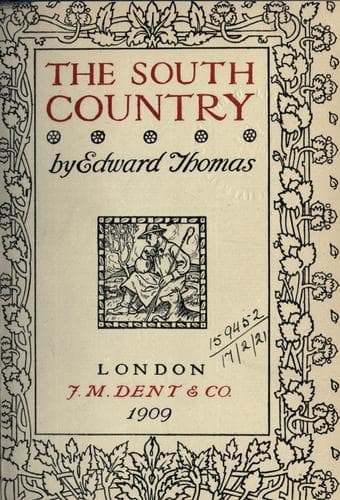
England -- Description and travel; Natural history -- England; Thomas, Edward, 1878-1917 -- Travel -- England
“What do you want with two beds?” he asked with a tinge of scorn as
well as of pity in his frank amusement. “My missus and I have only had
one bed these forty years.”
Here he laughed so gaily that he could not have embarrassed the very
devil of puritanism, and turning to his man he called forth a deep
bass laughter and from his wife a peal that shook her arms so that she
raised them to the sides of the porch for better support; the children
also turned their laughter our way.
“But perhaps one of you kicks in his sleep?... We don’t.... Come
inside. I dare say you are tired.... Good-night, John. Now, children,
up with you.”
I think they were the most excellent pair of man and woman I ever
saw. Both were of a splendid physical type, she the more energetic,
black-haired, black-eyed, plump and tall and straight; he the more
enduring, fair-haired and bearded, blue-eyed, hardly her equal in
height, certainly not in words. In forty years neither had overpowered
the other. They had not even agreed to take separate paths, but like
two school-boys, new friends, they could afford to contend together
in opinions without fear of damage or of lazy truce. He had ploughed
and sowed and reaped: she had borne him seven children, had baked and
churned and stitched. They had loved sweet things together, and, with
curses at times, their children and the land. Physical strength and
purity--that were in them the whole of morality--seemed to have given
them that equality with the conditions of life which philosophy has
done nothing but talk about. They of all men and women had perhaps
jarred least upon the music of the spheres. They had the right and
power to live, and the end was laughter.
In all those years they had been separated but once. Until four years
ago she had not been out of Cornwall except to bury her mother, who had
suddenly died in London. Two hundred pounds fell to her share on that
death and the money arrived one morning after the harvest thanksgiving.
For a week she continued to go about her work in the old way save that
she sent rather hurriedly for a daughter who had just left her place
as cook in Exeter. At the end of the week, having stored the apples
and shown her daughter how to use the separator, she walked in to
Penzance in her best clothes but without even a handbag; her husband
was out with his gun. By the next day she was at Liverpool. She sent
off a picture postcard, with a little note written by the shopkeeper,
saying that she would be back by Christmas, and telling her husband
to sell the old bull. Then she sailed for New York. She saw Niagara;
she visited her nephew, John Davy, at Cincinnati; she spent two weeks
in railway travelling west and south, and saw the Indians. Four days
before Christmas she was back in the rickyard, driving before her a
young bull and carrying in her hand a bunch of maize.
“Well, Ann, you’re back before your time,” said her husband, after
praising the beast.
Public-domain text, read in full here on John Shaqi.
Reviews
Reviews
No reviews yet
Be the first to share your thoughts on this work.
Elsewhere in the archive
Join the Discussion
Join the discussion
Sign in to leave a comment or review.
Sign InorCreate an account