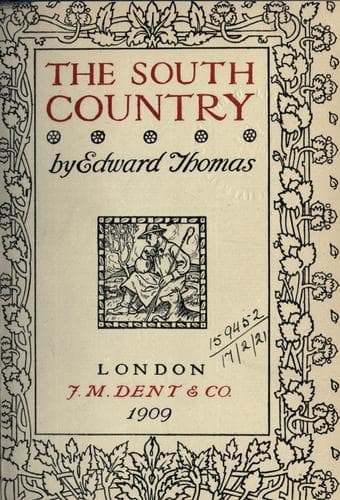
England -- Description and travel; Natural history -- England; Thomas, Edward, 1878-1917 -- Travel -- England
I like trees for the cool evening voices of their many leaves, for
their cloudy forms linked to earth by stately stems--for the pale
lifting of the sycamore leaves in breezes and also their drooping,
hushed and massed repose, for the myriad division of the light ash
leaves--for their straight pillars and for the twisted branch work,
for their still shade and their rippling or calm shimmering or dimly
glowing light, for the quicksilver drip of dawn, for their solemnity
and their dancing, for all their sounds and motions--their slow-heaved
sighs, their nocturnal murmurs, their fitful fingerings at thunder
time, their swishing and tossing and hissing in violent rain, the roar
of their congregations before the south-west wind when it seems that
they must lift up the land and fly away with it, for their rustlings
of welcome in harvest heat--for their kindliness and their serene
remoteness and inhumanity, and especially the massiest of the trees
that have also the glory of motion, the sycamores, which are the chief
tree of Cornwall, as the beeches and yews are of the Downs, the oaks
of the Weald, the elms of the Wiltshire vales.
Before I part from trees I should like to mention those of
mid-Somerset--and above all, the elms. I am thinking of them as they
are at noon on the hottest days of haymaking at the end of June. The
sky is hot, its pale blue without pity and changing to a yellow of mist
near the horizon. The land is level and all of grass, and where the hay
is not spread in swathes the grass is almost invisible for the daisies
on its motionless surface. Here and there the mower whirrs and seems
natural music, like the grasshopper’s, of the burning earth. Through
the levels wind the heavy-topped grey willows of a hidden stream.
In the hedges and in the wide fields and about the still, silent
farmhouses of stone there are many elms. They are tall and slender
despite their full mounded summits. They cast no shade. In the great
heat their green is all but grey, and their leaves are lost in the mist
which their mingling creates. Grey-hooded, grey-mantled, they seem to
be stealing away over the fields to the sanctuary of the dark-wooded
hills, low and round and lapped entirely in leaves, which stand in
the mist at the edge of the plain--to be leaving that plain to the
possession of the whirring mower and the sun of almighty summer.
Sycamores solemnized the Cornish farm in the twilight, where I asked
the farmer’s wife if she could let us have two beds for the night. She
stood in the doorway, hands on hips, watching her grandchildren’s last
excited minutes of play in the rickyard.
“He’s the master,” she replied, pointing to the farmer who was talking
to his carter, between the rickyard and the door, under the sycamores.
“Two beds?”
“That is what we should like,” said my friend and I.
Public-domain text, read in full here on John Shaqi.
Reviews
Reviews
No reviews yet
Be the first to share your thoughts on this work.
Elsewhere in the archive
Join the Discussion
Join the discussion
Sign in to leave a comment or review.
Sign InorCreate an account