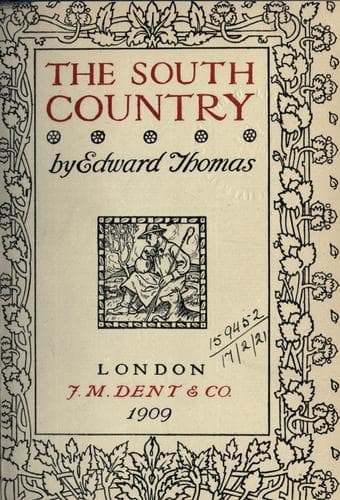
England -- Description and travel; Natural history -- England; Thomas, Edward, 1878-1917 -- Travel -- England
Beside her plays a dog, with lifted ears, head on one side, rosy
tongue bright against his yellow fur, waiting upon her fancies. His
rest and his motion, like hers, are careless and beautiful, gifts of
the sun, the wind and the earth. As I look at them I think of such a
child and such a playmate that lived two thousand years ago in the sun,
and once as they played each set a foot upon the soft clay of a tile
that the tile maker had not yet burned hard and red. The tile fell in
the ruin of a Roman city in Britain, was buried hundreds of years in
ashes and flowering mould, and yesterday I saw the footprints in the
dark red tile, two thousand years old.
A day follows of rain and wind, and it is the robin that is most heard
among the dripping thorns, the robin and his autumnal voice. But the
sky clears for sunset and the blackbird’s hour, and, as twilight ends,
only the rear of the disappearing procession of day cloud is visible on
the western horizon, while the procession of night has but sent up two
or three dark forerunners. The sky is of palest blue, and Jupiter and
Sirius are bright over the sea, Venus over the land and Mercury just
over the far oaks. The sea is very dark except at the horizon which is
pale with the dissolving remnant of sunset gold in it; but two ranks of
breakers throw up a waving vapour of fairy foam against the dark waves
behind.
Again there are roaring wet mornings and sunlit mornings, but in them
all the pewits wheel over the marsh and their wild cries mingle with
the sweet whimper of dunlins, the songs of larks, the glitter of the
dykes, the wall of rain. All day the sky over heathery moorland is
like a reduplication of the moorland, except that at the horizon the
sky clears at intervals and fleets of pure white cloud sail over the
dark ploughland and green pines; and the gentle sea is white only where
the waves break on the sand like a line of children in white frocks
advancing with wavers in the game of “Here we come gathering nuts and
may.” Or the west is angry, thick and grey, the snow is horizontal
and fierce, and yet the south has a bay of blue sky and in it a vast
sunlit precipice of white cloud, and the missel thrushes roll out their
songs again and again at the edges of many woods. Or a sun appears
that brings out the songs of thrush and chaffinch and lark, and leaves
a chequer of snow on pine and ploughland and on the mole hills of the
meadows. Again the sun disappears and the swift heavy hail rebounds
on the grass with a dancing as of sand-hoppers, and there is no other
sound except a sudden hedgesparrow’s song to break in upon the beating
of the pellets on hard ivy and holly and tender grass. In the frosty
evening the first moth comes to the lamp.
Public-domain text, read in full here on John Shaqi.
Reviews
Reviews
No reviews yet
Be the first to share your thoughts on this work.
Join the Discussion
Join the discussion
Sign in to leave a comment or review.
Sign InorCreate an account