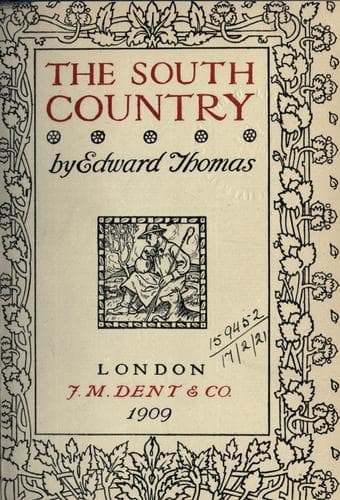
England -- Description and travel; Natural history -- England; Thomas, Edward, 1878-1917 -- Travel -- England
It is not enough to say merely that it was because they did not, as
some landscapes seem to do, enter into competition with Nature. The
spirit that raised and sculptured the Downs, that entered the beech and
made a melody of its silent towering and branching, that kept the sky
above alive and beautiful with the massiveness of mountains and the
evanescence of foam, was also in this man’s fingers. He was a great
lover of these things, and in his love for them combined the ecstasy
of courtship with the understanding of marriage. But he loved them too
well to draw and paint them. He was not of those who tear themselves
from a mistress to write a sonnet on her face. No. He painted the
images which they implanted--such was their love of him and his of
them--in his brain. There many a metamorphosis as wonderful as Ovid’s
was made. The beech-trees mingled with the fantasies of the brain and
brought forth holes that are almost human forms, branches that are
thoughts and roots that are more than wood. Often, I think, he hardly
looked at Nature as he walked, except to take a careless pleasure in
the thymy winds, in the drama of light and shade on the woods and
hills, in the sound of leaves and birds and water. Within him these
things lived a new life until they reached forms as different from
their beginnings as we are from Palæolithic man. They attained to that
beauty of which, as I have said, Nature was so little jealous, by
this evolution. Some of his pictures of the leaf-dappled branch-work
of beeches always remind me of the efflorescence of frost on a
window-pane, and the comparison is not purely fantastic but has a real
significance.
And yet the landscapes of this metamorphosis are not, as might have
been expected, decorations that have lost all smell of earth and light
of sun and breath of breeze. Decorative they certainly are, and I know
few pictures which are less open to the accusation of being scraps from
Nature, which it is more impossible to think of extending beyond the
limits of the frame. But such is the personality of the artist that
all this refinement only made more powerful than ever the spirit of
the motionless things, the trees, the pools, the hills, the clouds.
Frankly, there is a deep fund of what must narrowly, and for the moment
only, be called inhumanity in the artist, or he could not thus have
reinforced or intensified the inhumanity of Nature. Consider, for
example, his “Song of the Nightingale.” Those woods are untrodden woods
as lonely as the sky. They are made for the nightingale’s song to rule
in solitude under the crescent moon. No lovers walk there. Mortal who
enters there must either a poet or a madman be.
Public-domain text, read in full here on John Shaqi.
Reviews
Reviews
No reviews yet
Be the first to share your thoughts on this work.
Elsewhere in the archive
Join the Discussion
Join the discussion
Sign in to leave a comment or review.
Sign InorCreate an account