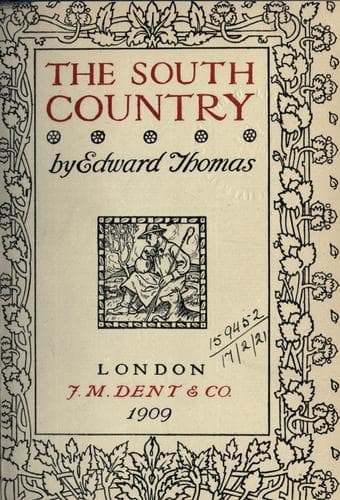
England -- Description and travel; Natural history -- England; Thomas, Edward, 1878-1917 -- Travel -- England
Look again at his “Castle in Spain,” how it is perched up above that
might of forest, like a child that has climbed whence it can never
descend. And the little house at the edge of the high, dark wood--in
“The Farm under the Hill”--is as frail and timid as if it heard the
roaring of wild beasts, and the little white road winds into the
darkness as to death. So, too, with the children who make a pretence
of playing hoops at the edge of just such another wood, though mortal
has never come out of it since the beginning of the world. The ship in
the “Fall of the Leaf” is subdued to the spirit of autumn as is the
poet subdued to the immense scenes of “Alastor.” To introduce an elvish
figure, as he has done, in “Will o’ the Wisp” was an unnecessary aid
to the elvishness of the scene itself. Indeed, his human or fantastic
figures seem to be sometimes as much out of place as a Yankee at the
court of King Arthur, though there are two notable exceptions--“The
Sower” and “The Weed Burner”--both figures towards which idolatry might
be excusable, so nobly do they represent labour in the field. And even
in “The Weed Burner” the boy seems bemused by the motion and savour
of the smoke that curdles up through the autumn air. The picture of a
forest pool is magical, but it repudiates the fairy altogether. Nothing
would be more out of place here than the kind of sucking harlequin or
columbine which is commonly foisted upon us as a fairy; for here is
something more desirable, the very forces which begot the fairies upon
a different age from ours. Even when he draws a house it is, I think,
for the house’s sake, for the sake of whatever soul it has acquired,
which men cannot take away. Was there ever such an inn as “The
Wispers”? The landlord is dead, the casks are dry, a rat has littered
on the top stair of the cellar, and the landlord says--
“’Tis late and cold, stir up the fire:
Sit close, and draw the table nigher;
Be merry, and drink wine that’s old,
A hearty medicine ’gainst a cold:
Your beds of wanton down the best,
Where you shall tumble to your rest;
I could wish you wenches too,
But I am dead, and cannot do.
Call for the best the house may ring,
Sack, white, and claret let them bring,
And drink apace, while breath you have;
You’ll find but cold drink in the grave:
Plover, partridge, for your dinner,
And a capon for the sinner,
You shall find ready when you’re up,
And your horse shall have his sup:
Welcome, welcome, shall fly round,
And I shall smile, though underground.”
I like the inn, but the spider loves it, and his webs bar the door
against all but ghostly travellers. The barn, again, with its doorway
opening upon the summer night, has a life of its own. The two figures
at the door are utterly dwarfed by its ancientness, its space, and the
infinite silence without.
Public-domain text, read in full here on John Shaqi.
Reviews
Reviews
No reviews yet
Be the first to share your thoughts on this work.
Elsewhere in the archive
Join the Discussion
Join the discussion
Sign in to leave a comment or review.
Sign InorCreate an account