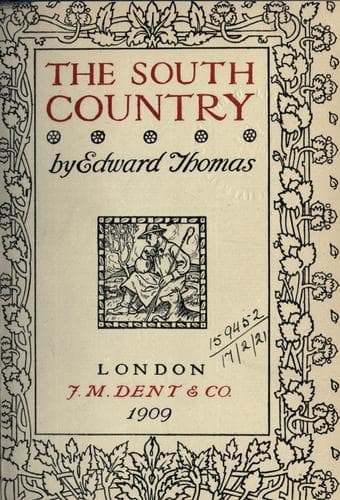
England -- Description and travel; Natural history -- England; Thomas, Edward, 1878-1917 -- Travel -- England
Several he rescued from the web
and then out of pity for the spider brought it flies already dead;
but finding that these were not to its taste he left the difficulty
unsolved and went sadly on his way. Almost equal to his pitifulness was
his dislike of work and his moral cowardice. Nothing could persuade him
to do any work, and such a coward was he that if he failed at the first
house where he offered his laces for sale he would not try again in
that village or town. Yet he did not scruple to steal--even with a hint
of physical violence--if he needed anything which chance presented to
him in another man’s possession: but he stole only necessaries, having
none of the acquisitiveness which is more common in their victims than
in thieves. Few men use leisure as well as he; perhaps no man was ever
idle with less harm to his fellows. The rich could have learned many
lessons at his feet: they must always be shooting or driving furiously
or meddling with politics or stopping footpaths; they cannot be kept
out of harm, however rich. How well this man would have employed money:
he would have given it away!
By and by his pity for goaded cattle and his frequent gazings into
their brown eyes as they stared at him by a stile still further reduced
his necessities--he would touch no meat; so that his companion, finding
him no longer of much use in spite of his possession of but one arm,
left him and only crossed his path at increasing intervals of time. It
was now that Jones remembered with horror a scene which had slumbered
in his mind with the fear which it originally roused in youth. He and
other boys were in the habit of peeping through a hole in the wall
of a slaughter-house and watching the slaughter, the skinning and
the cutting up, until their ears became familiar with the groans,
the screams, the gurglings, the squelchings in the half-darkness of
candle-light, the blood and white faces and the knife. But one day
there was led into the slaughter-house a white heifer fresh from the
May pasture, clean and bright from her gleaming rosy hoofs to the tips
of the horns that swayed as she walked. Her breath made, as it were, a
sacred space about her as the light of a human face will do. She stood
quiet but uncertain and musingly in the dark, soaked, half-ruinous
place, into which light only came in bars through a cobwebbed lattice
and fell that day upon her white face, leaving in darkness the tall
butcher and the imbecile assistant who held the rope by which the
animal’s head was drawn down to the right level for a blow. The men
were in no hurry and as the heifer was not restive they finished their
talk about Home Rule. Then the idiot tried to put her into the right
position, but for a time could not get her to see that her head must
be drawn tight and somewhat askew against the oaken pillar. He only
succeeded by patting her flanks and saying gently as if to a girl:
“Come along, Daisy!” She lowed soft and bowed her head; the blow fell;
Public-domain text, read in full here on John Shaqi.
Reviews
Reviews
No reviews yet
Be the first to share your thoughts on this work.
Elsewhere in the archive
Join the Discussion
Join the discussion
Sign in to leave a comment or review.
Sign InorCreate an account