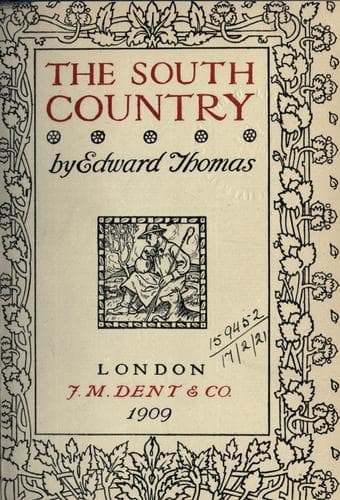
England -- Description and travel; Natural history -- England; Thomas, Edward, 1878-1917 -- Travel -- England
she rolled to the ground and the butcher once more let loose the heavy
scent of blood. The wholesome pretty beast, the familiar “Come along,
Daisy!” and the blow and the scent came often into Jones’ mind. He
ate no meat, but made no attempt to proselytize; he simply retreated
deeper and deeper into his childlike love of Nature. The birds and
the flowers and the creeping and running things he seemed to regard
as little happy, charming, undeveloped human beings, looking down on
them with infinite tenderness and a little amusement; with them alone
was he quite at home. Nature, as she presented herself to his simple
senses, was but a fragrant, many-coloured, exuberant, chiefly joyous
community, with which most men were not in harmony. Silent for days and
thinking only “green thoughts” under the branches of the wood, he came
to demand, unconsciously, that there should be such a harmony. But he
loved Nature also because she had no ambiguity, told no lies, uttered
no irony. Sitting among flowers by running water he wore an expression
of blessed satisfaction with his company which is not often seen at
the friendliest table. He drew no philosophy from Nature, no opinions,
ideas, proposals for reform, but only the wisdom to live, happily and
healthily and simply, himself.
I dare say modernity was in his blood, but no man seemed to belong less
to our time. Of history and science he knew nothing, of literature
nothing; he had to make out the earth with his own eyes and heart. He
had not words for it, but he felt that whatever he touched was God.
No myth or religion had any value to him. There were no symbols for
him to use. The deities he surmised or smelt or tasted in the air or
upon the earth had neither name nor shape. Had he been able to think,
he was the man to put our generation on the way to a new mythology.
For all I know, he had the vision, the power of the seer, without
the power of the prophet. A little more and perhaps he would have
invaded Christendom as St. Paul invaded Heathendom. Yet I think he
was not wholly the loser by being unable to think. The eye untroubled
by thought sees things like a mirror newly burnished; at night, for
example, the musing man can see nothing before him but a mist, but
if he stops thinking quickly the roads, the walls, the trees become
visible. So this man saw with a clearness as of Angelico, and in his
memory violets and roses, trees and faces were as clear as if within
his brain were another sun to light them. He had but to close his
eyes to see these things, an innumerable procession of days and their
flowers and their birds in the sky or on the bough. And this he had at
no cost. He employed only such labour as was needed to make his bread
and occasionally clothes and a pipe. Nor did he merely ask alms of
Nature and Civilization. He paid back countless charities to flower
and bird and child and poorer men, and there was nothing against him
of pain or sorrow or death inflicted. And as he was without religion
Public-domain text, read in full here on John Shaqi.
Reviews
Reviews
No reviews yet
Be the first to share your thoughts on this work.
Elsewhere in the archive
Join the Discussion
Join the discussion
Sign in to leave a comment or review.
Sign InorCreate an account