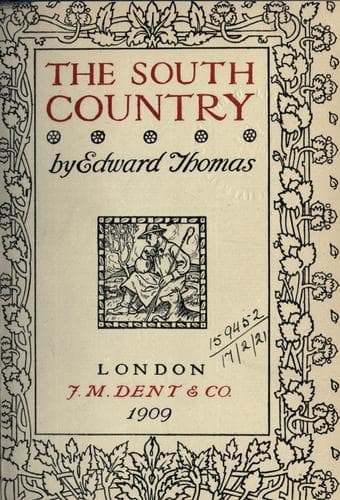
England -- Description and travel; Natural history -- England; Thomas, Edward, 1878-1917 -- Travel -- England
Why are there no swifts to race and scream? We fret over these stages
of the descending year; we dream on such a day as this that there is no
need of farther descent. We would preserve those days of the reaping;
we have lost them; but we recall them now when the steam-plough has
furrowed the sheeny stubble, and long for the day when the gentle
north wind can only just stir the clusters of aspen-leaves, and the
branches are motionless. The nut bushes hang dreamily, heavily, over
the white cool roads. The wood-pigeon’s is the sole voice in the oak
woods of the low hills, except that once or twice a swift screams as
he pursues that martial flight of his--as of one who swings a sword as
he goes--towards the beeches and hop gardens of the higher hills in
the north; it is perhaps the last day for more than eight months that
his cry will be heard. A few barley-straws hang from the hazels; some
leaves are yellow. Autumn, in fact, seems possible to the mind that is
not perfectly content with these calm sweet airs and the sense of the
fulness of things.
At a crossing a small island is made amidst this and three other roads,
and on the island stands an oast house with two mellow cones and
white leaning cowls; and beside it a simple tiled cart-lodge, dimly
displaying massive wheels, curving bulwarks of waggons and straight
shafts behind its doorless pillars of rough-hewn wood. Making one group
with these, though separated from them by one road, is an old red
farmhouse, of barely distinguishable timber and brick, with white-edged
dormers and lower windows and doors, entrenched behind hollyhocks of
deepest red and the burning discs of everlasting sunflowers. Behind the
gates stand four haystacks brightly thatched, and one that is dark and
old and carved into huge stairs.
Notice the gate into the rickyard. It is of the usual five oak bars;
and across these is a diagonal bar from the lowest end nearest the
hinge to the upper end of the opposite side, and from top to bottom a
perpendicular cross-bar divides the gate. The top bar marks it as no
common gate made at a factory with a hundred others of the same kind,
though there are scores of them in Kent. It thickens gradually towards
the hinge end of the gate, and then much more decidedly so that it
resembles a gun-barrel and stock; and just where the stock begins it
is carved with something like a trigger-guard; the whole being well
proportioned, graceful but strong. In all the best gates of Kent,
Sussex and Surrey and the South Country there is an approach to this
form, usually without the trigger-guard, but sometimes having instead a
much more elaborate variation of it which takes away from the dignity
and simplicity of the gate. At the road’s edge crooked quince-trees
lean over a green pond and green but nearly yellow straight reeds;
and four cart-horses, three sorrels and a grey, are grouped under one
stately walnut.
Public-domain text, read in full here on John Shaqi.
Reviews
Reviews
No reviews yet
Be the first to share your thoughts on this work.
Elsewhere in the archive
Join the Discussion
Join the discussion
Sign in to leave a comment or review.
Sign InorCreate an account