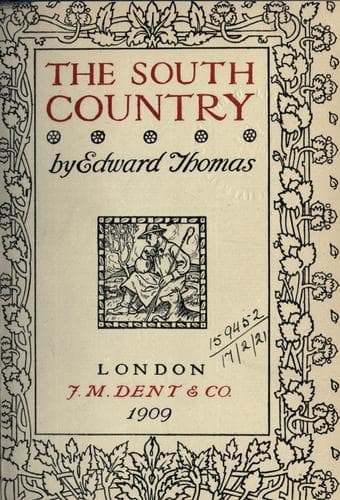
England -- Description and travel; Natural history -- England; Thomas, Edward, 1878-1917 -- Travel -- England
But a few days and the bryony leaves are palest yellow in the hedge.
Rooks are innumerable about the land, but their cawing, like all other
sounds, like all the early bronze and rose and gold of the leaves, is
muffled by the mist which endures right through the afternoon; and
all day falls the gentle rain. In the hillside hop garden two long
lines of women and children, red and white and black, are destroying
the golden green of the hops, and they are like two caterpillars
destroying a leaf. Pleasant it is now to see the white smoke from the
oast house pouring solidly like curving plumes into the still rain,
and to smell the smell, bitter and never to be too much sniffed and
enjoyed, that travels wide over the fields. For the hop drier has lit
his two fires of Welsh coal and brimstone and charcoal under the two
cones of the oast house, and has spread his couch of straw on the
floor where he can sleep his many little sleeps in the busy day and
night. The oast house consists of the pair of cones, white-vaned and
tiled, upon their two circular chambers in which the fires are lit.
Attached to these on one side is a brick building of two large rooms,
one upon the ground, where the hop drier sleeps and tends his fires,
lighted only by doors at either side and divided by the wooden pillars
which support the floor of the upper room. This, the oast chamber,
reached by a ladder, is a beautiful room, its oak boards polished by
careful use and now stained faintly by the green-gold of hops, its
roof raftered and high and dim. Light falls upon it on one side from
two low windows, on the opposite side from a door through which the
hops arrive from the garden. The waggon waits below the door, full of
the loose, stained hop-sacks which the carter and his boy lift up to
the drier. From the floor two short ladders lead to the doors in the
cones where the hops are suspended on canvas floors above the kilns.
The inside of the cone is full of coiling fumes which have killed the
young swallows in the nests under the cowl--the parents return again
and again, but dare no longer alight on their old perches on the vanes.
When dried the hops are poured out on the floor of the vast chamber in
a lisping scaly pile, and the drier is continually sweeping back those
which are scattered. Through a hole in the floor he forces them down
into a sack reaching to the floor of the room below. He is hard at
work making these sacks or “pokes,” which, when full and their necks
stitched up, are as hard as wood. Before the drying is over the full
sacks will take up half the room. The children tired of picking come
to admire and to visit all the corners of the room; of the granary
alongside and its old sheepbells, its traps, a crossbow and the like;
of the farmyard and barns, sacred except at this time. For a few
minutes the sun is visible as a shapeless crimson thing above the mist
and behind the elms. It is twilight; the wheels and hoofs of the last
Public-domain text, read in full here on John Shaqi.
Reviews
Reviews
No reviews yet
Be the first to share your thoughts on this work.
Elsewhere in the archive
Join the Discussion
Join the discussion
Sign in to leave a comment or review.
Sign InorCreate an account