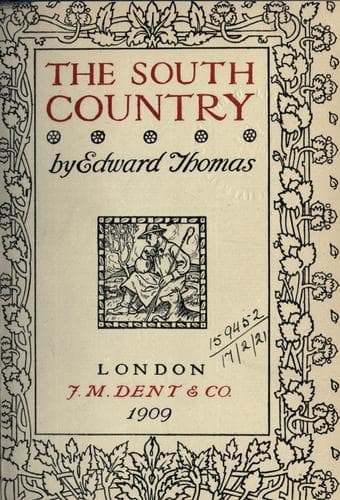
England -- Description and travel; Natural history -- England; Thomas, Edward, 1878-1917 -- Travel -- England
waggon approach and arrive and die away. And so day after day the fires
glow with ruby and sapphire and emerald; the cone wears its plume of
smoke; and everything is yellow-green--the very scent of the drying
hops can hardly be otherwise described, in its mixture of sharpness
and mellowness. Then when the last sack is pressed benches are placed
round the chamber and a table at one end. The master, who is giving up
the farm, leans on the table and pays each picker and pole-puller and
measurer, with a special word for each and a jest for the women. Ale
and gin and cakes are brought in, and the farmer leaves the women and
one or two older men to eat and drink. The women in their shabby black
skirts and whitish blouses shuffle through a dance or two, all modern
and some American. One old man tipsily tottering recalls the olden time
with a step-dance down the room; some laugh at him, others turn up
their new roseate noses. Next year the hops are to be grubbed up; the
old man to be turned out of his cottage--for he has paid no rent these
seven years; but now it is cakes and ale, and the farmer has hiccupped
a lying promise that his successor will go on growing hops.
HAMPSHIRE.
To-day is fair day. The scene is a green, slightly undulating common,
grassy and rushy at its lower end where a large pond wets the margin of
the high road, and at the upper end sprinkled with the dwarf and the
common gorse out of which rise many tumuli, green or furzy mounds of
earth, often surmounted by a few funereal pines. The common is small;
it is bounded on every side by roads, and on one by a row of new mean
houses; there is a golf-house among the tumuli; in one place a large
square has been ploughed and fenced by a private owner. But the slope
of the sandy soil is pleasant; in one place it is broken into a low
cliff overhanging the water, and this with the presence of the gorse
give it a touch of the wildness by which it may still deserve its name
of “heath.” Most powerful of all in their effect upon the place are the
tumuli. They are low and smooth; one or two scarcely heave the turf;
some have been removed; and there is no legend attached to them. Yet
their presence gives an indescribable charm and state, and melancholy
too, and makes these few acres an expanse unequalled by any other of
the same size. Not too far off to be said to belong to the heath, from
which they are separated by three miles of cultivated land and a lesser
beechen hill, are the Downs; among them one that bears a thin white
road winding up at the edge of a dark wood. In the moist October air
the Downs are very grave and gentle and near, and are not lost to sight
until far beyond the turreted promontory of Chanctonbury.
Public-domain text, read in full here on John Shaqi.
Reviews
Reviews
No reviews yet
Be the first to share your thoughts on this work.
Elsewhere in the archive
Join the Discussion
Join the discussion
Sign in to leave a comment or review.
Sign InorCreate an account