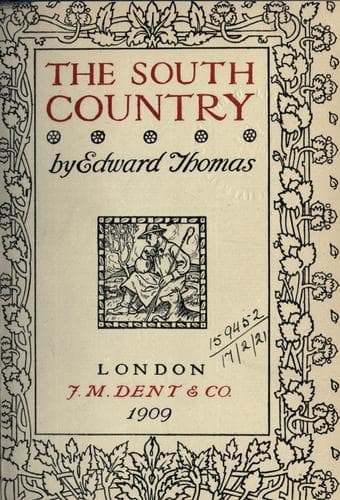
England -- Description and travel; Natural history -- England; Thomas, Edward, 1878-1917 -- Travel -- England
The name is given to the south of England as distinguished from the
Midlands, “North England”, and “West England” by the Severn. The poet
is thinking particularly of Sussex and of the South Downs. In using
the term I am thinking of all that country which is dominated by the
Downs or by the English Channel, or by both; Cornwall and East Anglia
have been admitted only for the sake of contrast. Roughly speaking,
it is the country south of the Thames and Severn and east of Exmoor,
and it includes, therefore, the counties of Kent, Sussex, Surrey,
Hampshire, Berkshire, Wiltshire, Dorset, and part of Somerset. East and
west across it go ranges of chalk hills, their sides smoothly hollowed
by Nature and the marl-burner, or sharply scored by old roads. On
their lower slopes they carry the chief woods of the south country,
their coombes are often fully fledged with trees, and sometimes their
high places are crowned with beech or fir; but they are most admirably
themselves when they are bare of all but grass and a few bushes of
gorse and juniper and some yew, and their ridges make flowing but
infinitely variable clear lines against the sky. Sometimes they support
a plateau of flint and clay, which slopes gradually to the level of
the streams. Sometimes they fall away to the vales in well-defined
ledges--first a long curving slope, then a plain of cornland, and
below that a steep but lesser slope covered with wood, and then again
grassland or sandy heaths and rivers. Except on the plateau, the
summits have few houses and very small hamlets; the first terrace
has larger villages and even a town or two; but most of the towns
are beneath on the banks of the rivers, and chiefly where they are
broadest near the sea, or on the coast itself. The rivers flow mainly
north and south, and can have but a short course before they enter the
sea on the south or the Thames on the north. Those I remember best
are the Stours, the two Rothers, but especially the one which joins
the Arun, the Medway, the Len, the Eden, the Holling, the Teise, the
Ouse, the Itchen, the Meon, the Wey, the Mole, the Kennet, the Ray,
the Winterbournes, the Wiltshire Avon, the Wylye, the Ebble, and many
little waters running gold over New Forest gravel or crystal over the
chalk of Hampshire, and not least of all that unlucky rivulet, the
Wandle, once a nymph that walked among her sisters--
So amiable, fair, so pure, so delicate,
So plump, so full, so fresh, her eyes so wondrous clear:
And first unto her lord, at _Wandsworth_ doth appear,
That in the goodly court, of their great sovereign _Tames_,
There might no other speech be had amongst the streams,
But only of this Nymph, sweet Wandel, what she wore;
Of her complexion, grace, and how herself she bore.
Public-domain text, read in full here on John Shaqi.
Reviews
Reviews
No reviews yet
Be the first to share your thoughts on this work.
Join the Discussion
Join the discussion
Sign in to leave a comment or review.
Sign InorCreate an account