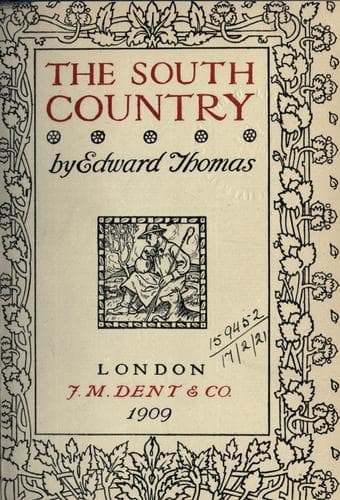
England -- Description and travel; Natural history -- England; Thomas, Edward, 1878-1917 -- Travel -- England
The fields where the green is now greenest, those bounded on two or
more sides by woods, are of a kind not peculiar to Hampshire. They are
usually on the greensand and lie in smooth, often winding, hollows
like the beds of rivers. Sometimes the banks of these beds are steep,
and they are clothed in woods or in hedges of hornbeam, hazel, ash and
thorn that have grown almost to woods. The meadows are green broad
rivers running up between the dark trees that bathe their roots in
primroses. Sometimes there is a stream of water running down the midst
of such a field, but as the stream, being a boundary, is often lined
with bushes, the particular charm is lost. In the perfect examples
there is the smoothness of the long hollowed meadow, the green, the
river-like form, the look of being a court or cloister between the
trees. Another kind of field of great charm is made by the convexity of
the land rising up from one side or both of such a hollow meadow. These
heaving fields, some of a regular domed shape, are favourites of the
sunset light, in spring when they are grassy, in August when they bear
corn: at noon when there are cattle grazing on the steep slope, their
shadows are an exact inversion of themselves, as in water.
* * * * *
Out of the rain and mist spring has now risen full-grown, tender and
lusty, fragrant, many-coloured, many-voiced, fair to see, so that it
is beyond a lover’s power to make even an inventory of her lovely
ways. She is tall, she is fresh and bold, sweet in her motion and in
her tranquillity; and there is a soft down upon her lip as there is a
silken edge to the young leaves of the beeches.
KENT.
Even the motor road is pleasant now when the nightingales sing out of
the bluebell thickets under oak and sweet chestnut and hornbeam and
hazel. Presently it crosses a common, too small ever to draw a crowd, a
rough up-and-down expanse of gorse and thorn, pierced by grassy paths
and surrounded by turf that is rushy and mounded by old ant heaps; and
here, too, there are nightingales singing alone, the sweeter for the
contrast between their tangled silent bowers and the sharp, straight
white road. The common is typical of the lesser commons of the south.
Crouch’s Croft in Sussex is another, in sight of the three dusk
moorland breasts of Crowborough; gorse-grown, flat, possessing a pond,
and walled by tall hollies in a hedge. Piet Down, close by, is a fellow
to it--grass and gorse and irregular pine--a pond, too--rough, like
a fragment of Ashdown or Woolmer, and bringing a wild sharp flavour
into the mellow cultivated land. Yet another is at Stone Street, very
small, a few oaks up to their knees in blackthorn, gorse and bramble,
with dusty edge and the hum of the telegraph wire for a song.
Public-domain text, read in full here on John Shaqi.
Reviews
Reviews
No reviews yet
Be the first to share your thoughts on this work.
Join the Discussion
Join the discussion
Sign in to leave a comment or review.
Sign InorCreate an account