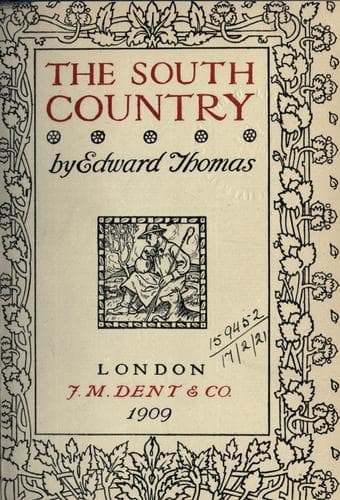
England -- Description and travel; Natural history -- England; Thomas, Edward, 1878-1917 -- Travel -- England
For a moment or less as he goes under the porch I seem to see that
England, that swan’s nest, that island which a man’s heart was not
too big to love utterly. But now what with Great Britain, the British
Empire, Britons, Britishers, and the English-speaking world, the choice
offered to whomsoever would be patriotic is embarrassing, and he is
fortunate who can find an ideal England of the past, the present, and
the future to worship, and embody it in his native fields and waters or
his garden, as in a graven image.
The round unending Downs are close ahead, and upon the nearest hill
a windmill beside a huge scoop in the chalk, a troop of elms below,
and then low-hedged fields of grass and wheat. The farms are those of
the downland. One stands at the end of the elm troop that swerves
and clusters about its tiled roof, grey cliff of chimney-stack, and
many gables; the stables with newer tiles; the huge slope of the
barn; the low mossy cart-lodge and its wheels and grounded shafts;
the pale straw stacks and the dark hay ricks with leaning ladders. A
hundred sheep-bells rush by with a music of the hills in the wind.
The larks are singing as if they never could have done by nightfall.
It is now the hour of sunset, and windy. All the sky is soft and
dark-grey-clouded except where the sun, just visible and throbbing in
its own light, looks through a bright window in the west with a glow.
Exactly under the sun the grass and wheat is full both of the pure
effulgence and of the south-west wind, rippling and glittering: there
is no sun for anything else save the water. North of the sun and out of
its power lies a lush meadow, beyond it a flat marshland cut by several
curves of bright water, above that a dark church on a wooded mound, and
then three shadowy swoops of Down ending at a spire among trees.
South-west, the jagged ridgy cluster of a hillside town, a mill and a
castle, stand dark and lucid, and behind them the mere lines of still
more distant downs.
CHAPTER VI
A RETURN TO NATURE
I turn into my next inn with unusual hopes. For it was here some years
ago that I met for the first time a remarkable man. It was nine o’clock
on a late July evening, and the haymakers, only just set free, came
stamping into the bar. The last waggon-load stopped at the door while
the red-whiskered carter stood, one hand on the latch, and drank his
pint before leading his horses into the stall. After the haymakers,
in their pale corduroys and dirty white slops, came a tall, spare,
shock-headed man, not recently shaved, dressed in grey--grey coat, grey
breeches and stockings, and a tall, hard felt hat that was old and
grey. He called for sixpenny ale, and wiping the hay dust from his neck
sat down beside me.
No, he is not here to-day. Perhaps he will never get out of London
again.
Public-domain text, read in full here on John Shaqi.
Reviews
Reviews
No reviews yet
Be the first to share your thoughts on this work.
Join the Discussion
Join the discussion
Sign in to leave a comment or review.
Sign InorCreate an account