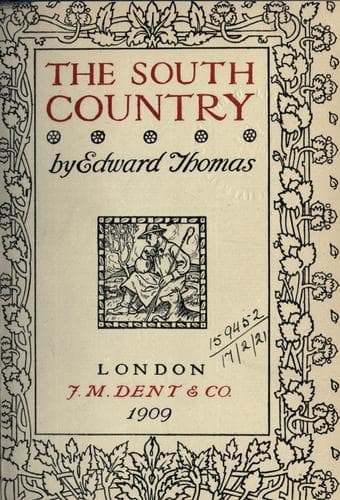
England -- Description and travel; Natural history -- England; Thomas, Edward, 1878-1917 -- Travel -- England
large men, occasionally lifted their arms as if to help forward the
contemptible procession; sometimes, with a quick motion of the hand,
they caused the straggling rear to double their pace for a few yards
by running with knees yet more bent and coat-tails flapping and hands
still deep in pockets--only for a few yards, for their walking pace was
their best, all having the same strength, the same middle height, the
same stride, though no two could be seen keeping step.
The traffic thickened, and amidst the horses that nodded and trampled
and the motor-cars that fumed and fretted the procession was closed up
into a grey block behind the donkey-cart. On one side of the donkey
was the black-bearded man, his right arm now resting on the animal’s
neck; on the other side the policemen; in front the standard-bearers
hung down their heads and held up their poles. Often the only remnant
visible was the raven crest of the leader.
The multitude on the pavement continued to press straight onward, or
to flit in and out of coloured shops. None looked at the standard,
the dark man and his cloudy followers, except a few of the smallest
newspaper boys who had a few spare minutes and rushed over to march
with them in the hope of music or a speech or a conflict. The straight
flower-girl flashed her eyes as she stood on the kerb, her left arm
curving with divine grace round the shawl-hidden child at her bosom,
her left hand thrust out full of roses. The tender, well-dressed women
leaning on the arms of their men smiled faintly, a little pitiful, but
gladly conscious of their own security and pleasantness. Men with the
historic sense glanced and noted the fact that there was a procession.
One man, standing on the kerb, took a sovereign from his pocket,
looked at it and then at the unemployed, made a little gesture of
utter bewilderment, and dropping the coin down into the drain below,
continued to watch. Comfortable clerks and others of the servile
realized that here were the unemployed about whom the newspapers
had said this and that--(“a pressing question”--“a very complicated
question not to be decided in a hurry”--“it is receiving the attention
of some of the best intellects of the time”--“our special reporter is
making a full investigation”--“who are the genuine and who are the
impostors?”--“connected with Socialist intrigues”)--and they repeated
the word “Socialism” and smiled at the bare legs of the son of man
and the yellow boots of the orator. Next day they would smile again
with pride that they had seen the procession which ended in feeble,
violent speeches against the Army and the Rich, in four arrests and an
imprisonment. For they spoke in voices gentle with hunger. They were
angry and uttered curses. One waved an arm against a palace, an arm
that could scarcely hold out a revolver even were all the kings sitting
in a row to tempt him. In the crowd and disturbance the leader fell and
fainted. They propped him in their arms and cleared a space about him.
Public-domain text, read in full here on John Shaqi.
Reviews
Reviews
No reviews yet
Be the first to share your thoughts on this work.
Join the Discussion
Join the discussion
Sign in to leave a comment or review.
Sign InorCreate an account