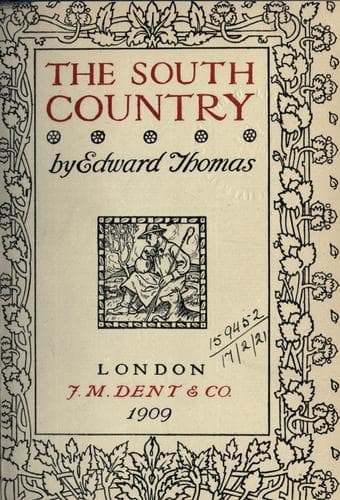
England -- Description and travel; Natural history -- England; Thomas, Edward, 1878-1917 -- Travel -- England
sea washing their bases. Capella hangs low, pale, large, moist and
trembling, almost engulfed between two horns of the wood upon the
headland, the frailest beacon of hope, still fluttering from the storm
out of which the land is emerging. Then, or at home looking at a map of
Britain, the West calls, out of Wiltshire and out of Cornwall and Devon
beyond, out of Monmouth and Glamorgan and Gower and Caermarthen, with
a voice of dead Townsends, Eastaways, Thomases, Phillipses, Treharnes,
Marendaz, sea men and mountain men.
Westward, for men of this island, lies the sea; westward are the great
hills. In a mere map the west of Britain is fascinating. The great
features of that map, which make it something more than a picture
to be imperfectly copied by laborious childish pens, are the great
promontories of Caernarvon, of Pembroke, of Gower and of Cornwall,
jutting out into the western sea, like the features of a grim large
face, such a face as is carved on a ship’s prow. These protruding
features, even on a small-scale map, thrill the mind with a sense of
purpose and spirit. They yearn, they peer out ever to the sea, as
if using eyes and nostrils to savour the utmost scent of it, as if
themselves calling back to the call of the waves. To the eyes of a
child they stand for adventure. They are lean and worn and scarred with
the strife and watching. Then gradually into the mind of the child
comes the story that justifies and, still more, inspires and seems
to explain those westward-pointing promontories. For, out towards
them continually have the conquered races of the world retreated,
and their settlements give those corners a strangeness and a charm to
our fantastic sympathies. Out from them conquerors in their turn have
gone to found a legend like the Welsh Madoc, an empire like the men
of Devon. The blood of conquered and conqueror is in our veins, and
it flushes the cheek at the sight or thought of the west. Each man of
us is as ancient and complicated, as lofty-spired and as deep-vaulted
as cathedrals and castles old, and in those lands our crypts and
dark foundations are dimly remembered. We look out towards them from
the high camps at Battlesbury and Barbury: the lines of the Downs
go trooping along to them at night. Even in the bosom of the South
Country, when the tranquil bells are calling over the corn at twilight,
the westward-going hills, where the sun has fallen, draw the heart
away and fill us with a desire to go on and on for ever, that same
way. When, in the clear windy dawn, thin clouds like traveller’s joy
are upon the high air, it seems that up there also, in those placid
spaces, they travel and know the joy of the road, and the sun--feeding
on the blue, as a child said yesterday, as Lucretius said before--goes
the desired way. London also calls, making the needle whirl in the
compass. For in London also a man may live as up “a great river wide
as any sea”; and over some of the fairest of the South Country hangs
Public-domain text, read in full here on John Shaqi.
Reviews
Reviews
No reviews yet
Be the first to share your thoughts on this work.
Join the Discussion
Join the discussion
Sign in to leave a comment or review.
Sign InorCreate an account