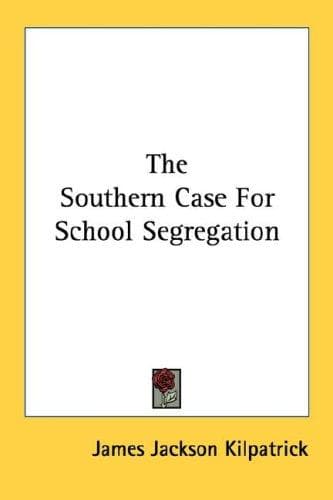
The Southern Case for School SegregationKilpatrick, James Jackson
History
The Southern Case for School Segregation
Kilpatrick, James Jackson
African Americans -- Segregation; Segregation -- Southern States
We consider this decision utterly unsound on the facts; contrary
to the clear intent of the Fourteenth Amendment; a usurpation of
legislative function through judicial process; and an invasion of
the reserved rights of States. We further consider that, _putting
aside the question of segregation_, this decision presents a clear
and present danger to our system of constitutional government,
because it places what the court calls “modern authority” in
sociology and psychology above the ancient authority of the law,
and because it places the transitory views of the Supreme Court
above the legislative power of Congress, the settled construction
of the Constitution, and the reserved sovereignty of the several
States. [Emphasis supplied.]
If the student of American government can do as the Sibley commission
suggests, and put aside the question of segregation--eliminate all
the emotional overtones of “prejudice” and “discrimination” and
“second-class citizens”--he will get a clearer picture of the most
disturbing aspect of the _School Segregation Cases_. One of the most
cherished myths of American tradition, as strong and as insubstantial
as any doctrine of religion, is that ours is “a government of laws,
not men.” Viewed coldly and nakedly, the proposition is palpably
absurd; wine is wine, and bread is bread. But by some devout act of
political transubstantiation, the faith of the American people has
imbued this doctrine with a special venerability: We have been reared
to believe that law exists metaphysically, above and beyond the
mortal men who enforce it. As an institution, the high court commands
respect, not for the nine frail vessels beneath the robes, but out of
deference to the higher, holier grail they represent.
And this was what the court shattered in the _Brown_ case: The myth,
the grail, the mystery of the law. “The judicial function is that
of interpretation,” Sutherland once said; “it does not include the
power of amendment under the guise of interpretation.” Cardozo said
the same thing: “We are not at liberty to revise while professing
to construe.” Hughes said it too: “The power of this court is not
to amend, but only to expound the Constitution as an agency of the
sovereign people who made it and who alone have authority to alter or
unmake it.”
But the court disdained these ancient and elementary rules. “By its
decision in the _Brown_ case,” former Justice Byrnes has said, “the
court did not interpret the Constitution. It really amended the
Constitution.” This the court had no legal or moral right to do. It
had only the power to do it--the absolute power, in Acton’s famous
phrase, that left unrestrained, corrupts absolutely.
Part III
Prayer of the Petitioner
Public-domain text, read in full here on John Shaqi.
Reviews
Reviews
No reviews yet
Be the first to share your thoughts on this work.
Elsewhere in the archive
Join the Discussion
Join the discussion
Sign in to leave a comment or review.
Sign InorCreate an account