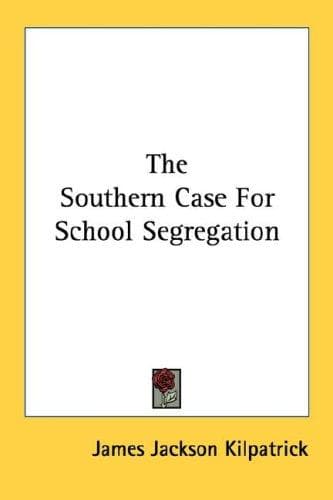
The Southern Case for School SegregationKilpatrick, James Jackson
History
The Southern Case for School Segregation
Kilpatrick, James Jackson
African Americans -- Segregation; Segregation -- Southern States
Judge Parker quoted from an opinion by the District of Columbia’s
Judge E. B. Prettyman, an outstanding jurist who had considered
the question a year earlier in _Carr_ v. _Corning_ (182 F.2d 14).
There Judge Prettyman raised the question of whether the Fourteenth
Amendment had lifted the entire problem of race relations out of the
hands of all legislatures and settled it. “We do not think it did,”
he said. “Such problems lie naturally in the field of legislation, a
method susceptible of experimentation, of development, of adjustment
to the current necessities in a variety of community circumstance. We
do not believe that the makers of the first ten amendments in 1789 or
of the Fourteenth Amendment in 1866 meant to foreclose legislative
treatment of the problem in this country. This is not to decry
efforts to reach that state of common existence which is the obvious
highest good in our concept of civilization. It is merely to say
that the social and economic inter-relationship of two races living
together is a legislative problem, as yet not solved, and is not a
problem solved fully, finally or unequivocally by a fiat enacted many
years ago. We must remember that on this particular point we are
interpreting a Constitution and not enacting a statute.”
Judge Parker went on in his own opinion to review decisions of
the Supreme Court sustaining the separate-but-equal doctrine, and
to distinguish between education at the graduate-school level and
education at the elementary-school level. In dealing with the grammar
schools, under systems of compulsory attendance, local lawmakers have
problems of educational policy that must take into account not only
questions of instruction “but also of the wishes of the parent as
to the upbringing of the child and his associates in the formative
period of childhood and adolescence.” If public education is to
have the support of the people through their legislatures, Judge
Parker said, “it must not go contrary to what they deem for the best
interests of their children.” The plaintiffs’ expert witnesses had
testified that mixed schools would benefit children of both races
by exposing them to democratic opportunities in community living.
Defense witnesses, on the other hand, had testified that mixed
schools would result in friction and tension. Said the court:
Public-domain text, read in full here on John Shaqi.
Reviews
Reviews
No reviews yet
Be the first to share your thoughts on this work.
Elsewhere in the archive
Join the Discussion
Join the discussion
Sign in to leave a comment or review.
Sign InorCreate an account