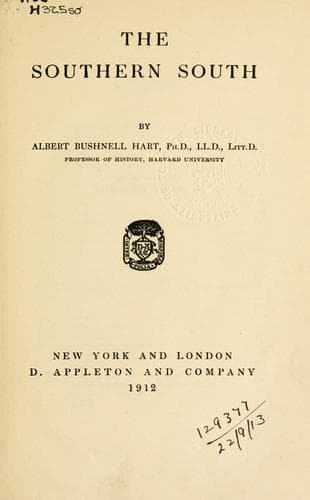
Southern States -- Social conditions; United States -- Race relations
It is not, however, certain that the Negroes have accumulated in their own
hands so much as the value of one year's output. A. H. Stone, a practical
planter, says that, on his plantation, negro property was irregularly
subdivided; his renters had property accumulated to an average of $400 a
family, while the share hands did not average $50 a family. That is, the
greater part of the negro property is owned by the smaller part of the
population. That is not peculiar to Negroes; in New York City nearly the
whole property is said to be owned by 20,000 people; and in Galveston most
of the valuable real estate is said to be in the hands of, or controlled
by, a score of individuals. In the cities and towns, many prosperous
Negroes are rent payers, and own no real estate, but there may be 50,000
owners besides the 190,000 farm owners. In Kentucky half the Negroes who
are working land independently own their farms. Even in Mississippi the
owners and renters together are more than the share hands.
Since no Negro can successfully rent unless he owns mules and farm tools,
and the renters are considerably more numerous than the owners, we may add
250,000 more families on the land who have accumulated something. That
makes 550,000 families, or between a third and a fourth of the Southern
Negroes, who are getting ahead. If the 550,000 families averaged $900 each
of land and personal property they would hold $500,000,000; $900 is,
however, a high figure, and it may be roughly estimated that negro land
owners and renters had accumulated in 1900 not more than $300,000,000 or
$400,000,000 worth of property. The rest of the Southern Negroes are about
7,000,000 in number; at the low average of $15 a head of accumulations
they would count up nearly $150,000,000 more. A fair estimate of negro
wealth in the South, therefore, would be something above $500,000,000, and
constantly rising.
Public-domain text, read in full here on John Shaqi.
Reviews
Reviews
No reviews yet
Be the first to share your thoughts on this work.
Elsewhere in the archive
Join the Discussion
Join the discussion
Sign in to leave a comment or review.
Sign InorCreate an account