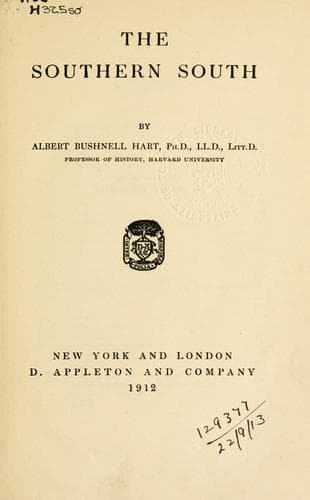
Southern States -- Social conditions; United States -- Race relations
This estimated proportion is confirmed by investigations into taxes paid
by Negroes. In 1902 the 2,100,000 Negroes in the four states of Virginia,
North Carolina, Georgia, and Arkansas were assessed for taxes on
$54,000,000. At the same proportion throughout the South, their assessment
would have been about $170,000,000, which by this time has probably
increased to over $200,000,000; and $200,000,000 is a fortieth of the
present total assessment. The sum is great, but the proportion to the
wealth of the South is small. At best it can be said that the Negroes, who
are a third of the population, own a fortieth of the property in the
South; and that one fourth of the Negroes own four fifths of all the negro
property. The taxes do not tell the whole story, and there are probably
rich Northern cities in which the poorest third of the population does not
directly pay more than a fortieth of the taxes. If a race is to be held up
as worthless because it is not on the tax books, what will become of some
of the most lively members of the Boston City Council and New York Board
of Aldermen? Everybody knows that in every community the poorest people
pay the largest proportionate taxes through their rent, and through the
increased cost of living which is pushed down upon them by landlords and
storekeepers. If the colored people were all to move out of their
tenements and farms and to go on general strike and earn nothing with
which to buy their supplies, the taxpayers of record would very quickly
find out who paid a part of their taxes for them. Nevertheless, whatever
excuses are made for him, it is undeniable that the Negro has no such
spirit of acquisition, no such willingness to sacrifice present delight
for future good, as the Northern immigrant, or even the Southern Poor
White.
CHAPTER XII
RACE ASSOCIATION
In the preceding chapters the effort has been made to analyze and describe
the white race and the negro race, each as though it lived by itself, and
could work out its own destiny without reference to the other. The white
race is faced with the necessity of elevating its lower fourth; the negro
race should be equally absorbed in advancing its lower three fourths. In
both races there is progress and there is hope; if either one were living
by itself it might be predicted that in a generation or two the problems
would cease to be specially Southern and would come down to those which
besiege all civilized communities. But neither race lives alone, neither
can live alone. The commercial prosperity of the Whites largely depends on
negro labor; high standards for the negro race depend on white aid and
white example; neither race is free, neither race is independent. They are
the positive and negative poles of a dynamo, and terrific is the spark
that sometimes leaps from one to the other.
Public-domain text, read in full here on John Shaqi.
Reviews
Reviews
No reviews yet
Be the first to share your thoughts on this work.
Elsewhere in the archive
Join the Discussion
Join the discussion
Sign in to leave a comment or review.
Sign InorCreate an account