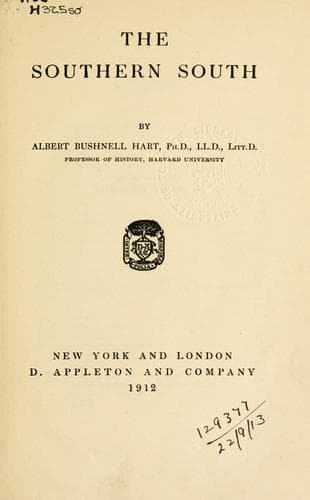
Southern States -- Social conditions; United States -- Race relations
In slavery days almost all the discussion of race questions came from the
Whites, Southern or Northern. Now, there is a school of negro
controversialists and observers, several of whom have had the highest
advantages of education and of a personal acquaintance with the problems
which they discuss, and thus possess some advantages over many white
writers. About twenty years ago George W. Williams published his "History
of the Negro Race in America" (1883), which, though to a large degree a
compilation, is a respectable and useful book. Another writer, William H.
Thomas, in his "The American Negro" (1901), has made admissions with
regard to the moral qualities of his fellow Negroes which have been widely
taken up and quoted by anti-Negro writers. Charles W. Chesnutt, in several
books of collected stories, of which "The Conjure Woman" (1899) is the
liveliest, and in two novels, "The House Behind the Cedars" (1900) and the
"Marrow of Tradition" (1901), has criticised the rigid separation of
races. No man feels more keenly the race distinctions than one like
Chesnutt, more Caucasian than African in his make-up. One of the best of
their writers is Kelly Miller, who has contributed nearly fifty articles
to various periodicals upon the race problems; and in humor, good temper,
and appreciation of the real issues, shows himself often superior to the
writers whom he criticises. The most systematic discussion of the race by
one of themselves is William A. Sinclair's "The Aftermath of Slavery"
(1905), which, though confused in arrangement and unscientific in form, is
an excellent summary of the arguments in favor of the negro race and the
Negroes' political privileges.
The most eminent man whom the African race in America has produced is
Booker T. Washington, the well-known president of Tuskegee. In addition to
his numerous addresses and his personal influence, he has contributed to
the discussion several volumes, partly autobiographic and partly didactic.
His "Up from Slavery" (1901) is a remarkable story of his own rise from
the deepest obscurity to a place of great influence. In three other
volumes, "Character Building" (1902), "Working with the Hands" (1904), and
"The Negro in Business" (1907), he has widened his moral influence upon
his race. "The Future of the American Negro" (1899) is the only volume in
which Washington discusses the race problem as a whole; and his advice
here, as in all his public utterances, is for the Negro to show himself so
thrifty and so useful that the community cannot get on without him.
Public-domain text, read in full here on John Shaqi.
Reviews
Reviews
No reviews yet
Be the first to share your thoughts on this work.
Join the Discussion
Join the discussion
Sign in to leave a comment or review.
Sign InorCreate an account