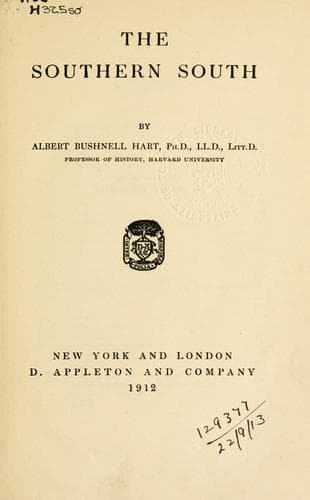
Southern States -- Social conditions; United States -- Race relations
One practical Southern cotton planter has devoted much time and attention
to the scientific study of the conditions on his own plantation and
elsewhere as a contribution toward a judgment of the race problem. This is
Alfred H. Stone, of Greenville, Miss., who has published half a dozen
monographs, several of which are gathered into a volume, under the title
"Studies in the American Race Problem" (1908). He is now engaged, under
the auspices of the Carnegie Institution, on a study of the whole
question. He has visited several Southern states and the West Indies,
and brings to his inquiries the point of view of an employer of Negroes
who wishes them well and sees the interest of his country in the
improvement of negro labor. Perhaps his judgment is somewhat affected by
the special conditions of Mississippi and of his own neighborhood, in
which the Negroes are very numerous and perhaps more than usually
disturbing. The results of his latest investigations will appear under the
title "Race Relations in America"; and may be expected to be the most
thorough contribution to the subject made by any writer.
Among less formal publications are the negro periodicals, which are very
numerous and include _Alexander's Magazine_ and a few other well-written
and well-edited summaries of things of special interest to the race. The
whole question has become so interesting that several of the great
magazines have taken it up. The _World's Work_ devoted its number of June,
1907, almost wholly to the South; and the _American Magazine_ published in
1907-8 a series of articles by Ray Stannard Baker on the subject. In 1904
the _Outlook_ published a series of seven articles by Ernest H. Abbott
based upon personal study. An interesting contribution is the so-called
"Autobiography of a Southerner," by "Nicholas Worth," published in the
_Atlantic Monthly_ in 1906. Whoever Nicholas Worth may be, there can be no
doubt as to his Southern birth, training, and understanding, nor of his
excellent style, sense of humor, and power to make clear the growth of
race feeling in the South since the Civil War.
All these and many other printed materials are at the service of the
Northern as of the Southern investigator. Among their contradictory and
controversial testimony may be discerned various cross currents of
thought; and their statements of fact and the results of their
researches form a body of material which may be analyzed as a basis for
new deductions. But nobody can rely wholly on printed copy for knowledge
of such complicated questions. Books cannot be cross-examined nor
compelled to fill up gaps in their statements. The investigator of the
South must learn the region and the people so as to take in his own
impressions at first hand. Printed materials are the woof; but the warp of
the fabric is the geography of the South, the distribution of soil, the
character of the crops, the habits of the people, their thrift and
unthrift, their own ideas as to their difficulties.
Public-domain text, read in full here on John Shaqi.
Reviews
Reviews
No reviews yet
Be the first to share your thoughts on this work.
Join the Discussion
Join the discussion
Sign in to leave a comment or review.
Sign InorCreate an account