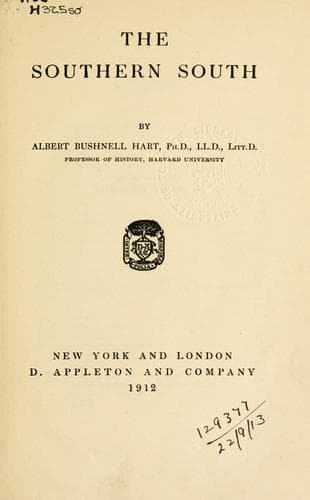
Southern States -- Social conditions; United States -- Race relations
The methods of the lynchers are very simple. In 1906 a white man, accused
of murdering his brother, on whose case the jury had disagreed, was
dragged out of jail and shot. In a great many cases the supposed criminal
is hunted down by what is called a "posse"--really a self-appointed body
of furious neighbors; and very seldom is there the semblance of
investigation. If the offender is lodged in jail, that sanctuary of the
law is often invaded. In August, 1906, a mob of three thousand men,
incited by a person who afterwards proved to be a released convict, broke
open the jail at Salisbury, N. C., in despite of addresses by the mayor
and United States senator, took out and killed three supposed negro
criminals. Occasionally, when a criminal has been tried, convicted, and is
awaiting execution, he is taken out and lynched, for the excitement of
seeing the man die, and perhaps from fear that he will be pardoned.
Naturally, in this quick method, mistakes sometimes occur. At Brookhaven,
Miss., on January 2, 1908, a Negro was lynched for killing a white man; a
few days later they caught the actual murderer, but consoled themselves
with the belief that inasmuch as the first Negro was wounded when
captured, the presumption was that he must have killed some other white
man. A few days later, at Dothan, Ala., a Negro was taken out, hanged, and
two hundred shots fired at him, but was found the next morning alive and
unwounded, and was allowed to escape. In a recent case at Atlanta a Negro
positively identified by the victim of a most serious crime was allowed to
go to trial, and was acquitted, because the court believed him innocent,
and the woman subsequently identified another man.
Public-domain text, read in full here on John Shaqi.
Reviews
Reviews
No reviews yet
Be the first to share your thoughts on this work.
Elsewhere in the archive
Join the Discussion
Join the discussion
Sign in to leave a comment or review.
Sign InorCreate an account