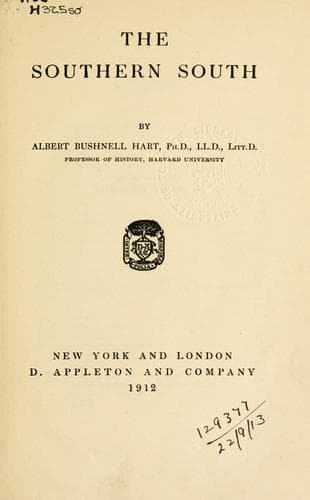
Southern States -- Social conditions; United States -- Race relations
How does it come about that these mobs, composed invariably of white men
and none others, cannot be put down by the white authorities? The first
reason is that there are no rural police in the South to make prompt
arrests and protect prisoners; the sheriffs upon whom the custody of such
persons depends are chosen by popular election, and usually have no
backbone; one of them who had actually lodged his prisoners in jail said
that he hated to do it, and didn't know how he could meet his neighbors.
Jailors commonly give up their keys after a little protest; there are few
cases where a determined sheriff, armed and ready to do his duty, could
not quell a mob; but what can be expected of a sheriff who turns over a
prisoner to the mob in order that they may "investigate" his crime?
Occasionally a sheriff shows some pluck, and in December, 1906, President
Roosevelt singled out for federal appointment a sheriff who had lost his
reëlection because he had opposed a mob. Governors are sometimes very
weak-kneed; a few years ago the governor of North Carolina delivered up to
a mob a colored boy who had had such confidence in the Superior Race as to
come to the executive mansion and ask for protection. At Annapolis, in
1908, neither the sheriff, jailor, nor municipal authorities made any
effort to prevent the taking out of a prisoner; in Chattanooga, Sheriff
Shipp, who permitted a Negro to be taken out of his hands and lynched,
though the sheriff had been served by telegram with an order from a
justice of the Supreme Court directing him to protect the criminal, was
reëlected by a large majority; and apparently did not lose popularity when
a year later he was sentenced to ninety days' confinement for contempt of
court.
In all the Southern states the last state resort for keeping the peace is
the militia, and there have recently been two scandalous instances where
these volunteer soldiers have permitted themselves to be overrun by a mob,
giving up their guns without an effort to fire a shot. In one of these
cases it was recorded that "No effort was made to hurt any of the soldiers
however, as it was plain to the crowd that they had gained their point."
At Brookhaven, Miss., in 1908, the officer commanding the militia excused
himself because the sheriff had not asked him to order his men to fire.
These brave soldiers, these high-toned Southern gentlemen, these military
heroes, called out for the special purpose of protecting a prisoner, would
not draw a trigger!
Public-domain text, read in full here on John Shaqi.
Reviews
Reviews
No reviews yet
Be the first to share your thoughts on this work.
Elsewhere in the archive
Join the Discussion
Join the discussion
Sign in to leave a comment or review.
Sign InorCreate an account