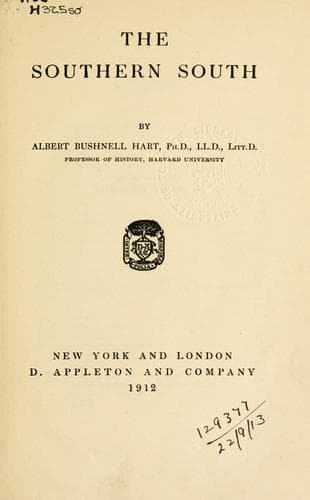
Southern States -- Social conditions; United States -- Race relations
Physically, the Southern States differ much both from their Northeastern
and their Northwestern neighbors. No broken country like New England
reaches down to the coast; no rocky headlands flank deep natural harbors;
there are, except in central Alabama and in Texas, no treeless prairies.
Three of these states, South Carolina, Georgia, and Alabama, include
mountain regions which, though interesting in themselves, are little
related to the great problem of race relations and of race hostility.
Physically, they protect the cotton belt from the North, and thus affect
the climate; and they are fountains of water power as yet little
developed. South of the mountains and thence westward through northern
Mississippi, Louisiana, and Texas, is a hill region which is from every
point of view one of the parts of the South most interesting and at the
same time least known by Northerners. This is the traditional home of the
Poor Whites; whose backwardness is in itself a problem; whose industry
contributes much more than the world has been prone to allow to the wealth
of the South; and whose progress is one of the most encouraging things in
the present situation, for they furnish the major part of the Southern
voters. The hills are still heavily wooded, as was the whole face of the
country as far as central Texas, when it was first opened up by Europeans.
The hill region is also the theater of most of the manufacturing in the
South, and especially of the cotton mills.
Below the hills is a stretch of land, much of it alluvial, extending from
lower North Carolina to central Texas, which is the most characteristic
part of the South, because it is the approved area of cotton planting, the
site of great plantations, and the home of the densest negro population.
The central part of it is commonly called The Black Belt originally
because of the color of the soil, more recently as a tribute to the color
of the tillers of the soil, for here may be found counties in which the
Negroes are ten to one, and areas in which they are a hundred to one. It
includes some prosperous cities, like Montgomery and Shreveport, and many
thriving and increasing towns; but it is preëminently an agricultural
region, in which is to be settled the momentous question whether the Negro
is to stay on the land, and can progress as an agricultural laborer.
Public-domain text, read in full here on John Shaqi.
Reviews
Reviews
No reviews yet
Be the first to share your thoughts on this work.
Join the Discussion
Join the discussion
Sign in to leave a comment or review.
Sign InorCreate an account