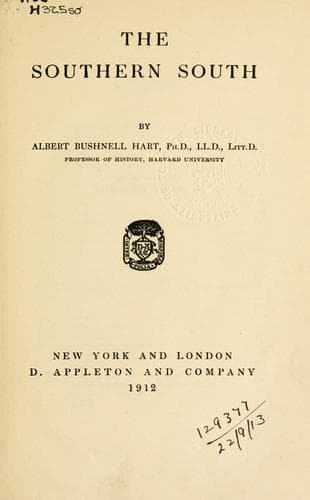
Southern States -- Social conditions; United States -- Race relations
Northerners do not understand the significance of the fertilizer in cotton
culture. George Washington was one of the few planters of his time who
urged his people to restore the vitality of their land as fast as they
took it out; but rare was the planter up to the Civil War who raised
cattle, and the imported guano from the rocky islets of the Gulf and
Pacific was little used. Then in the seventies discoveries were made of
phosphate rocks in the estuaries of the Carolina rivers; and later, inland
deposits in Tennessee. From these, with some admixture of imported
materials, are made commercial fertilizers which have become indispensable
to a large number of the cotton farmers, so that they are now spending 20
millions a year on that alone, every dollar of which is expected to add at
least a dollar and a half to the value of the crop.
The word "plantation" has come to have a special meaning in Northern ears.
It brings to the mind the great colonnaded mansion house with trim
whitewashed negro quarters grouped about it, the pickaninnies running to
open the gate for the four-in-hand bringing the happy guests, while back
in the cotton field the overseer rides to and fro cracking his blacksnake
whip. That kind of plantation is not altogether a myth. For instance, at
Hermitage, just outside of Savannah, you see a brick mansion of a few
large rooms, built a hundred years ago, surrounded by attractive sunken
gardens, and one of the most superb groves of live oaks in the South; and
near it are the original little brick slave cabins of one room and a
chimney.
That kind of elaborate place was rare; in most cases the ante-bellum
planter's house was a modest building, and nowadays very few large
planters live regularly on the plantation. If the place is profitable
enough, the family lives in the nearest town or city; if it is
unprofitable, sooner or later the banks get it and the family goes down;
even where the old house is preserved, it is likely to be turned over to
the manager, or becomes a nest for the colored people. Inasmuch as cotton
raising is an industrial enterprise, plantations are apt to change hands,
or the owners may put in new managers; so that the ante-bellum feeling of
personal relation between the owner and the field hand plays little part
in modern cotton making.
The modern plantation can more easily be described than analyzed; the term
is elastic; a young man will tell you that he has "bought a plantation"
which upon inquiry comes down to a little place of less than a hundred
acres with two houses. The distinction between a "farm" and a "plantation"
seems to be that the latter term is applied to a place on which there is a
body of laborers (almost universally Negroes) managed, with very few
exceptions, by white men and devoted principally to one crop.
Public-domain text, read in full here on John Shaqi.
Reviews
Reviews
No reviews yet
Be the first to share your thoughts on this work.
Elsewhere in the archive
Join the Discussion
Join the discussion
Sign in to leave a comment or review.
Sign InorCreate an account