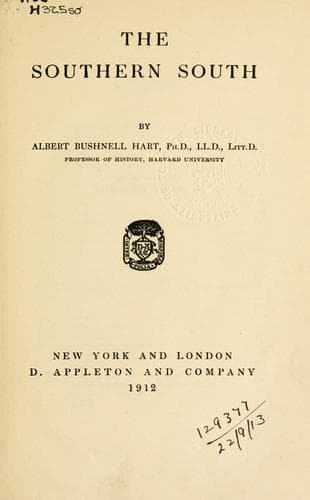
Southern States -- Social conditions; United States -- Race relations
Individual plantation holdings vary in size from the thirty thousand acres
of Bell, the central Alabama planter, down to fifty acres. Many large
owners have scattered plantations, sometimes as many as twenty or thirty,
each carried on by itself; or two or three adjacent groups under one
manager. You are informed that the X brothers "own thirty-three
plantations," which probably means thirty-three different large farms,
ranging from two hundred to two thousand acres each. Three to five
thousand acres of land under cultivation is as large a body of land as
seems advantageous to handle together.
A fair example of the large plantation in the best cotton lands is the
estate managed by Mr. Dayton near Jonesville, La., on the Tensas and
Little rivers. It is an expanse of that incredibly rich land, of which
there are millions of acres in this enormous delta, land which has in many
places produced fifty to seventy-five successive crops of cotton without
an ounce of fertilizer. Between the rivers, which are fenced off by
levees, lie the fields, originally all wooded, but in these old
plantations even the roots have disappeared from the open fields, although
wherever the plantation is enlarged the woods have to be cleared, and the
gaunt and fire-scarred dead trunks mark the progress of cultivation.
The negro houses stand in the middle of the field; for on modern
plantations it is very rare to gather the hands in quarters near the great
house; their cabins are distributed all over the estate. On the main road
is a manager's house, distinctly better than any of the negro cabins. Near
by a white family is moving in where a black family has moved out, for
this plantation (though the thing is uncommon) has a few white hands
working alongside the Negroes. In this free open, in the breadth of the
fields and the width of the turbid streams, alongside the endless
procession of scenic forests in the background, one forgets the long hot
days of toil, the scanty living, the ignorance and debasement. It may all
be as sordid as the mines or the iron works, but it is in pure air. These
thousands of broad acres with their mealy brown soil bearing the
"cotton-weed" (the common name for the stalk after the cotton is picked)
are a type of the lowland South from Texas to North Carolina.
Public-domain text, read in full here on John Shaqi.
Reviews
Reviews
No reviews yet
Be the first to share your thoughts on this work.
Elsewhere in the archive
Join the Discussion
Join the discussion
Sign in to leave a comment or review.
Sign InorCreate an account