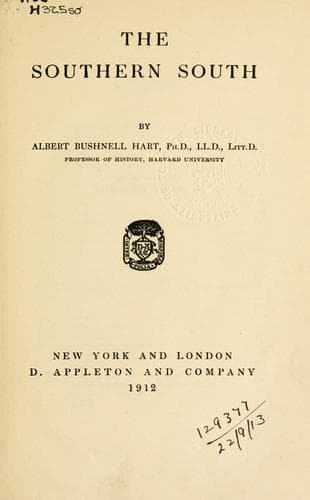
Southern States -- Social conditions; United States -- Race relations
Everybody in the great cotton districts talks about "A bale to the acre"
as a reasonable yield, but one of the richest counties of Mississippi
averages only half a bale, and the whole South averages about a third of a
bale. What is a bale? The "seed cotton," so called, as it comes from the
field, has the brown seeds in the midst of the fiber, and the first
process is to gin it--that is to take out the seed, and at the same time
to make it into the standard package for handling. This requires
machinery, originally invented by that ingenious Yankee schoolmaster, Eli
Whitney. There are about 38,000 of these ginneries, some having one poor
little old gin, others five or six of the latest machines side by side,
with air suction and other labor-saving devices. It is an interesting
sight to see the fluffy stuff wafted up into the gin with its row of
saw-teeth, and then blown to the press, where a plunger comes down time
after time until the man who runs it judges that about five hundred pounds
have accumulated; then another plunger comes up from below; the
rectangular mass thus formed is enveloped in rough sacking and fastened
with iron cotton ties. The completed bale is then turned out, weighed,
numbered, stamped, and recorded; and becomes one of the thirteen million
units of the year's crop; but the number identifies it, and any particular
bale of cotton may be traced back to the plantation from which it came and
even to the negro family that raised it. Sea Island cotton has a much
woodier plant, and the seed cotton contains less lint and more numerous
although smaller seeds; hence it requires special picking, a special gin,
cannot be so compressed, and must be much more carefully bagged. Sea
Island cotton at 23 cents a pound is thought to be no more profitable than
the short staple at less than half the price.
About 1897 a great effort was made to substitute a round bale, weighing
about half as much as the standard bale, and in 1902 the output reached
nearly a million. It is still a question whether that package is not an
improvement, but the machinery was more expensive, complaints were made
that the round bale was harder to stow for export; the railroad companies
refused to give any advantage in freight rates; and the compressor
companies, who are closely linked in with the railroads, were opposed to
it altogether; and the round bale has almost disappeared from the South.
Only two per cent of the cotton is thus baled.
Public-domain text, read in full here on John Shaqi.
Reviews
Reviews
No reviews yet
Be the first to share your thoughts on this work.
Elsewhere in the archive
Join the Discussion
Join the discussion
Sign in to leave a comment or review.
Sign InorCreate an account