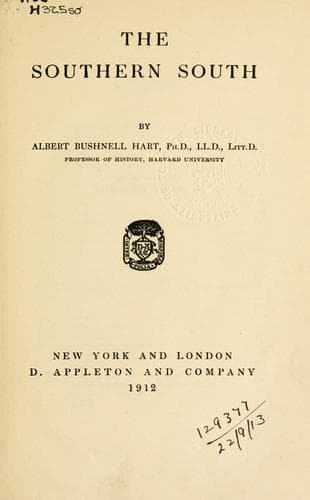
Southern States -- Social conditions; United States -- Race relations
Even where the Negro is employed on wages, he looks on himself as part of
the concern and expects due consideration in return for what Stone calls
the "proprietary interest he feels in the plantation at large, his sense
of being part and parcel of a large plantation. Then, too, there is his
never-failing assurance of ability to pay his account, no matter how
large, by his labor, when it is not too wet or too cold, his respect, and
his implicit and generally cheerful obedience."
Inasmuch as more than half the Negroes are raising cotton, and most of the
others are working on farms, it is important to know what kind of laborers
they make. It is the opinion of their greatest leader, Booker Washington,
that the best place for the Negro is in the rural South, and that he is
not fitted for the strife of the great cities South or North. Is he
perfectly fitted for any service? Is it true, as one of the employers of
Negroes alleges, that "their actions have no logical or reasonable basis,
that they are notional and whimsical, and that they are controlled far
more by their fancies than by their common sense?"
In cotton culture there is little to elevate a man. One of the numerous
errors flying about is that the slave in the cotton fields was a skilled
laborer, and that there is intellectual training in planting, weeding, and
picking. The owner or renter must of course accustom his mind to consider
the important questions of the times of plowing and seeding, and he must
submit to the anxiety which besets the farmer all over the world; but
cotton culture is a monotonous thing, the handling of the few tools is at
best a matter of dexterity, and the only man who gets an intellectual
training out of it is the manager. When cotton is high, a plantation is a
more or less speculative investment, and many people who save money put it
into land and hire a manager. Cotton broking and banking firms sometimes
carry on plantations of their own. City bankers and heavy men get
plantations on mortgage, or by purchase; and banks sometimes own too much
of this kind of property.
Public-domain text, read in full here on John Shaqi.
Reviews
Reviews
No reviews yet
Be the first to share your thoughts on this work.
Elsewhere in the archive
Join the Discussion
Join the discussion
Sign in to leave a comment or review.
Sign InorCreate an account