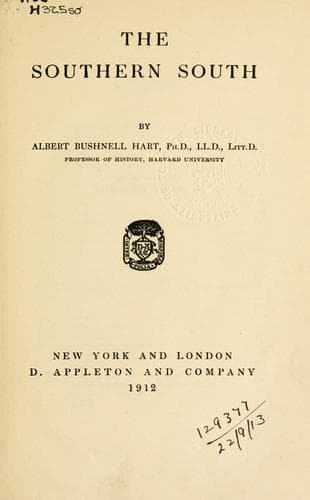
Southern States -- Social conditions; United States -- Race relations
The advance system is complicated by a system of "Christmas Money." You
hear planters bitterly cursing the Negroes who have demanded $25, $50, or
$100 to spend at Christmas time, as though the money were not charged
against the Negro to be deducted at the end of the year; and as though it
were not so advanced in order to induce the Negro to make a contract with
them. Many planters refuse to give Christmas money and yet fill up their
plantation houses. It is all part of a vicious system; the wage hands have
to be paid somehow, though often not completely paid up till the end of
the year; the share hands and renters are carried by the planter because
they always have been carried; and because bad planters can take advantage
of this opportunity to squeeze their hands. The difficulty is one known in
other lands; in Ceylon, for instance, the laborers on tea and rubber
estates draw advances, carry debts which have to be assumed by a new
employer, trade at a "caddy," which is the same thing as a commissary, and
complain of the accounts.
The system is just as vicious for the small land owners both negro and
white. Most Southern states under their crop lien law allow the growing
crop to be mortgaged for cash or advances, and hence any farmer has credit
for supplies or loans up to the probable value of the crop when marketed.
That value is variable, the advances are clogged with interest and
overcharges, and the whole system is a heavy draft on the country. There
are money sharks in the Southern country as well as in the Northern
cities, and many scandalous transactions. One man in Alabama has 2,500
Negroes on his books for loans, in some cases for a loan of $5 with
interest charges of $1.50 a month. Cases have been known where a Negro
brought to a plantation his mules and stock, worked a season, and at the
end saw all his crop of cotton taken, and his property swept up, including
the mules, which are exempt by law. Many back plantations take the seed
for the ginning--that is, they exact more than twice what the service is
worth. A Negro has been known to borrow say $200; when it was not paid,
the white lender seized on all his possessions, and without going through
any legal formality gave him credit for $100, leaving the balance of the
debt hanging over his head. A peddler has been known to insist on leaving
a clock at the house of a poor colored woman who protested that she did
not want a clock, could not afford a clock and would not take a clock. The
man drove off, returned some months later, demanded payment for the clock
which was just where he left it, never having been started, and when the
money was not forthcoming proceeded to take away the woman's chickens--her
poor little livelihood. She ran to a white neighbor, who came back with
her and turned the scoundrel out. There is first and last much of this
advantage taken of the ignorance and poverty of the Negro; a certain type
Public-domain text, read in full here on John Shaqi.
Reviews
Reviews
No reviews yet
Be the first to share your thoughts on this work.
Elsewhere in the archive
Join the Discussion
Join the discussion
Sign in to leave a comment or review.
Sign InorCreate an account