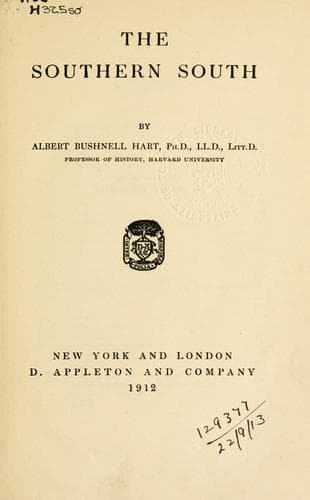
Southern States -- Social conditions; United States -- Race relations
of planter declares that he can make more money out of an ignorant black
than out of an educated one. As one of the white friends of the colored
race in the South says, the Negroes must receive at least sufficient
education to enable them to protect themselves against such exaction.
Considering the immense importance of cotton to the South, it is amazing
how wasteful is its culture and its distribution. Experts say that a great
part of the cost of fertilizers could be saved by cultivating the cow
pea. About six per cent of the value of the fiber--a trifle of forty
million dollars--is seriously injured by ginning. Comparatively few
farmers or planters select their seed, though several of the Southern
agricultural colleges have set up cotton schools, and the president of the
Mississippi Agricultural and Mechanical College has actually begun to hold
farmers' institutes for the negro farmers. The cotton bale is probably the
most careless package used for a valuable product. It sometimes literally
drops to pieces before it reaches the consumer; and of course the grower,
in the long run, loses by the poor quality or the poor packing of his
product. The grading of cotton requires that a large quantity be brought
together in one place, and the small grower gets little advantage out of
improvement in his staple.
What the South most needs in cotton is the improvement of the labor. As
President Hardy, of the Mississippi Agricultural College, says: "So many
of our negroes are directing their own work that their efficiency must be
preserved and increased or great injury will result to our whole economic
system. The prosperity of our section as a whole is affected by the
productive capacity of every individual in our midst. The negro's
inefficiency is a great financial drain on the South, and I believe this
farmers' institute work for the negro is the beginning of a permanent
policy that will be very far-reaching in its results. There is no doubt
that this is one of the ways of increasing the cotton production of the
country that has heretofore received very little attention."
Public-domain text, read in full here on John Shaqi.
Reviews
Reviews
No reviews yet
Be the first to share your thoughts on this work.
Elsewhere in the archive
Join the Discussion
Join the discussion
Sign in to leave a comment or review.
Sign InorCreate an account