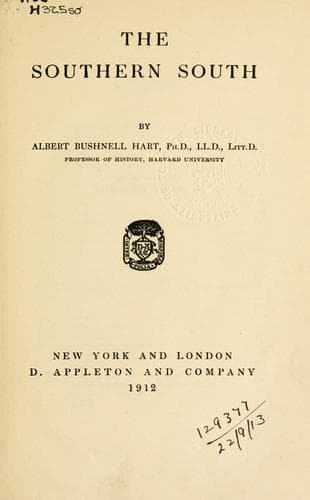
Southern States -- Social conditions; United States -- Race relations
Though agriculture is the predominant interest in the South, it is coming
forward rapidly in other pursuits, and is putting an end to differences
which for near a century have marked off the two sections. Down to the
Civil War the South hardly touched its subterranean wealth in coal and
iron, and knew nothing of its petroleum or its stores of phosphate rock.
Mining has now become a great industry, especially in Alabama, and the
states north and northwestward to Virginia. The manufacture of iron has
kept pace, and indeed has stimulated the development of the mines; and
Birmingham is one of the world's centers in the iron trade. Cotton mills
also have sprung up; and, as will be shown later, think they are disputing
the supremacy of New England. Though the Black Belt shares little in these
industries, or in the city building which comes along with them, it has
two local industries, namely, the ginning of cotton and the manufacture of
cotton-seed oil, together with a large fertilizer industry.
The South is not without drawbacks such as all over the world are the
penalty for the fruitfulness of semi-tropical regions. While, with the
exception of the lower Mississippi, perhaps no day in the summer is as hot
as some New York days, the heat in the Lower South is steady and
unyielding; and though the Negroes and white laborers keep on with little
interruption and sunstrokes are almost unknown, the heat affects the
powers, at least of the Whites, to give their best service. Colleges and
schools find it harder to keep up systematic study throughout the academic
year than in similar Northern institutions.
The South is much more infested by poisonous snakes, ticks, fleas, and
other like pests than the North, and though the climate is so favorable
for an all-the-year-round outdoor life these creatures put some
limitations on free movement. The low country also abounds in swamps, many
of them miles in extent, which if drained might make the most fertile soil
in the world; but, as they lie, are haunts of mosquitoes, and therefore of
malaria. Deaths by malarial fever, which are almost unknown in the North,
mount up to some hundreds in Southern cities, and in the lowlands,
particularly of the Mississippi and the Sea Islands, every white new-comer
must pay the penalty of fever before he can live comfortably. The people
accept these drawbacks good-humoredly and often ignore them, but they make
life different from that of most parts of the North.
Public-domain text, read in full here on John Shaqi.
Reviews
Reviews
No reviews yet
Be the first to share your thoughts on this work.
Join the Discussion
Join the discussion
Sign in to leave a comment or review.
Sign InorCreate an account