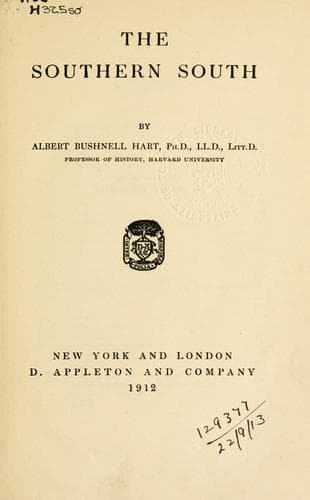
Southern States -- Social conditions; United States -- Race relations
One of the few benefits conferred by the Reconstruction governments was a
system of general public schools nominally open to every child in city or
country; but just as the education of Negroes and Poor Whites was
beginning, the schools were separated for the two races, and the Negroes
were cut off from Southern white teachers. To start the new system there
was no tradition of public school training and management, little sense of
public duty in laying sufficient taxes, and the South was very poor. Hence
it was about 1885 before the South put into operation a general
educational system, supported by public taxation. The most recent
statistics available (for 1906) show over 6,000,000 common school pupils
in the South, besides 380,000 pupils in private schools, 118,000 pupils in
public high schools, and 34,000 more in private secondary schools; 38,000
students in public and private universities, colleges and schools of
technology. Every Southern state has now worked out some system of both
rural and urban public schools, and several of them have a sizable State
school fund which is distributed among the districts. The ordinary type of
rural school is practically the district school of the North over again.
City schools are graded in the usual fashion. Most states have a State
Superintendent of Education, and the more progressive communities like
Louisiana are introducing county superintendents with power to compel good
schools. Surely with so many people and so much money, all must be happy
in the South. It is an educational army, with common school infantry,
secondary school cavalry, and in the institutions of higher learning the
heavy artillery and the big guns. Yet it is an army in which every
division, brigade, and regiment is divided into two camps, in which spear
clashes on shield, for hardly anything in the South so brings out into
relief the race question as the problem of education, and especially of
negro education.
The Reconstruction governments made no provision for public high schools,
but the growth of towns and cities in the South and the need of
preparatory schools for the colleges, and the public sense of the value of
secondary education, have compelled the founding of a great number of such
schools, both for girls and boys. Normal schools have also developed till
there are 45 with over 10,000 students. The colleges are also flourishing;
and of professional schools the South has more than 160, with above 12,000
students.
Public-domain text, read in full here on John Shaqi.
Reviews
Reviews
No reviews yet
Be the first to share your thoughts on this work.
Elsewhere in the archive
Join the Discussion
Join the discussion
Sign in to leave a comment or review.
Sign InorCreate an account