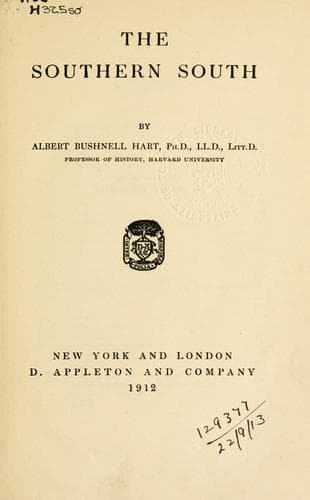
Southern States -- Social conditions; United States -- Race relations
Like England in the Eighteenth Century the South abounded in readers of
good literature, while the land was full of ignorance. Though in early
Virginia suggestions were made for free common schools, and Thomas
Jefferson strenuously advocated them, though in the forties and fifties
several Southern states had elaborate paper systems of schools, outside
the large cities there were no graded schools open to all white children
such as were familiar in the North after 1840. Even New Orleans waited for
good school buildings till the fortunate bequest of McDonogh; as for free
rural schools, not a single Southern state had organized and set in
operation a system before the Civil War. From the first the sparse
settlement of the South, the presence of the Negro, and the lack of that
commercial connection with the rest of the world which so arouses the
human mind, made it difficult and perhaps impossible to found a system of
general popular education in that region.
For the higher education of the dominant class much more was done.
Beginning with William and Mary in 1692--the first colonial college except
Harvard--many colleges were established. The first state university was
North Carolina, founded in 1790; the first American university of the
German type was the University of Virginia, which began operations in
1825; the first institution to introduce coeducation was Blount College,
which, about 1800, conferred the degree of A.B. upon a woman. But for
various reasons there never were money enough, students enough, and
trained educators enough to man the Southern colleges that were founded;
and secondary schools to feed the colleges were lacking. The girls had a
few boarding schools, some of which were called colleges by courtesy, but
their education was superficial. Many students who could afford it found
their way to Northern colleges, and that is why John C. Calhoun, the
apostle of slavery, was a Yale graduate, and Barnwell Rhett, the
protagonist of secession, was a graduate of Harvard.
After the Civil War came a dismal period, when some of the old
universities were closed for want of means and of professors who could
take the oath of allegiance. The training of the children of the best
families at that period has been thus described by one who experienced it:
"The schools that I attended--may God forgive the young women who one
after another taught the children of the sparsely settled
neighborhood--were farces and frauds. There was no public school.... We
lived in sort of a secluded training place for Southern gentlemen.... We
never saw a newspaper.... The professor of mathematics--so a rumor
ran--was a freethinker. He was said to have read Darwin and become an
evolutionist. But the report was not generally believed; for, it was
argued, even if he had read Darwin, a man of his great intellect would
instantly see the fallacy of that doctrine and discard it."
Public-domain text, read in full here on John Shaqi.
Reviews
Reviews
No reviews yet
Be the first to share your thoughts on this work.
Elsewhere in the archive
Join the Discussion
Join the discussion
Sign in to leave a comment or review.
Sign InorCreate an account