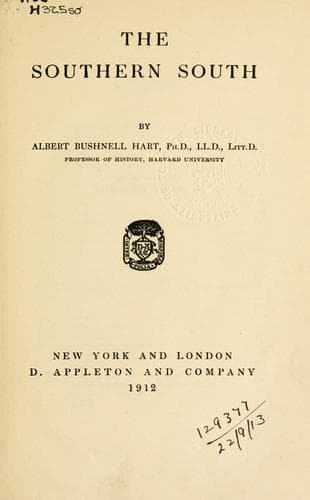
Southern States -- Social conditions; United States -- Race relations
The rural white schools are a different matter. It is, to be sure, nearly
thirty years since old Bill Williams explained why there was no school in
the Clover Bottom district in the Kentucky mountains: "They couldn't have
no school because there wasn't nary door or winder in the schoolhouse.
I've got that door and winder, and I paid a dollar for 'em; but I've been
keeping 'em, you see, because there was trouble about the title. Jim
Harris gin us that land, and we 'lowed 'twas all right, because it
belonged to his gran'ther and he was the favorite grandson; but when the
old man died it 'peared like he had willed it to somebody else; and I
wouldn't put no door nor winder into no schoolhouse where there ain't no
title, and there hain't been no school there sence. You want to know when
all that trouble happened 'bout the title? I reckon it was fifteen or
twenty year ago." There are still just such schools or rather such no
schools in many parts of the South.
Even in prosperous regions, buildings, apparatus, and teacher may be
alike, dirty and repellent. Take, for instance, Mt. Moriah school in Coosa
County, Alabama. The building is twenty-five feet square, inclosing a
single room with two windows and two doorways, one of them blocked up. In
the middle is an iron stove, around which on a winter's day are parked
four benches in a hollow square, upon which, or studying in the corner,
huddle and wriggle twenty-three pupils, ranging from seven up to
twenty-one years of age. They are reading physiology aloud, in the midst
of the gaunt room, with very little in the way of blackboards or
materials. An example of the better district schoolhouse is in a populous
region near the mill town of Talassee; a new building with eleven windows,
well ceiled throughout, with a clean gravel space in front, good desks and
plenty of blackboard.
The curse of many of the rural schools is their easy money, for all the
Southern states have a system of state school funds, the income of which
is subdivided among the districts, and is in some of them about enough to
keep up school three or four months on the usual scale of payment to
teachers. When the school fund is exhausted, great numbers of districts
close their schoolhouses, and the result is that the average number of
school days in a year is far below that of Northern schools. In
Massachusetts, Connecticut, and Rhode Island the public schools are in
session about 190 days; in Georgia, 118; in Arkansas, 87. These are
averages; and since the city schools commonly run seven or eight months,
there must be many districts in which there are not over fifty or sixty
days' school. One of the great educational reforms now going on in the
South is to secure from the local governments appropriations to continue
the schools after the state fund runs out. When the South is sufficiently
aroused to the blessing of education, it will find that it has money
enough for its needs.
Public-domain text, read in full here on John Shaqi.
Reviews
Reviews
No reviews yet
Be the first to share your thoughts on this work.
Elsewhere in the archive
Join the Discussion
Join the discussion
Sign in to leave a comment or review.
Sign InorCreate an account