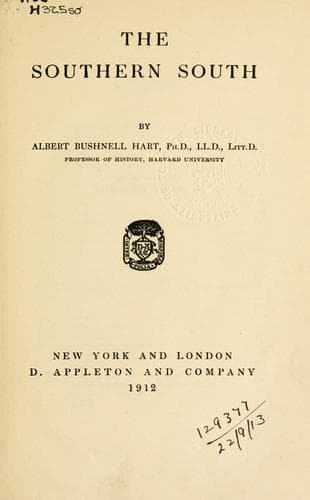
Southern States -- Social conditions; United States -- Race relations
Another defect is in the schoolhouses. The Southern towns and cities are
coming to follow the example of the West and North in putting up imposing
school buildings, though there is no such need for elaborate heating
apparatus and ventilation as in the North, and they are in general
simpler. The country schoolhouse is in many cases a big, dirty hut, often
built of logs, wretchedly furnished, and devoid of the commonest
appliances of civilization. There seems to be a feeling throughout the
South that schoolhouses cannot be built wholly out of taxation, but the
people on the ground must contribute at least a part of the cost. You may
find neat and tidy rural schoolhouses, actually painted, but they are far
from typical.
Another difficulty is the teachers. The monthly salaries for white
teachers in several of the Southern states are high. A Coosa County farmer
complains that a teacher in his district is getting $3.50 a day for twenty
days in the month, which was more than any farmer in the district could
earn. But of course her $70.00 a month would only run while school was in
session, which might be five months. In Louisiana rural teachers receive
higher salaries than in any other state in the Union, and no commonwealth
is making such determined effort to improve its rural schools. In the
remoteness of Catahoola Parish may be seen a system of wagonettes to bring
children to central graded schools, a reform which goes very slowly in New
England.
A further reason for the backwardness of the Southern rural schools is
that they are in the hands of county superintendents, whose place until
recently has too often been political. Now there is a body of trained
superintendents who are giving people object lessons in what can be done
even with poor buildings by well-trained teachers. The South is also
bending its energies on normal schools, and the result is a growing body
of teachers with professional spirit, who expect to make the schools their
life work. The state superintendents are also improving in their
professional power. The worst Southern rural schools are not too much
behind those that Horace Mann found in Massachusetts when he began his
work in 1837; the wages of the rural teachers are probably not so low as
those in Maine; and the next decade will see a vast improvement in the
rural schools throughout the South.
Public-domain text, read in full here on John Shaqi.
Reviews
Reviews
No reviews yet
Be the first to share your thoughts on this work.
Elsewhere in the archive
Join the Discussion
Join the discussion
Sign in to leave a comment or review.
Sign InorCreate an account