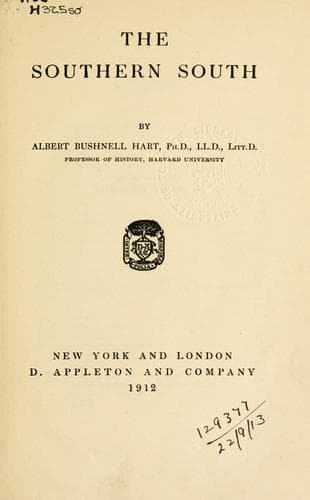
Southern States -- Social conditions; United States -- Race relations
In the South as in the North, there are two types of institutions of
higher learning, the endowed (in most cases denominational) and the
public. The number of Southern colleges is considerable; 166 out of 493 in
the United States--which is not far from the proportion of the population;
but only 8 of these institutions have upward of 500 undergraduate
students, as against 42 in the rest of the Union; and the total number of
undergraduate students in universities, colleges, and technological
schools, 25,300, is about a fifth of the total of 122,000 in the United
States, while the normal proportion would be a third. The property of the
Southern colleges ($99,000,000) is about a fifth of the total college
property; the income of $7,300,000 is about a sixth of the whole, the
benefactions in 1906 ($2,400,000) about a seventh. That is, in number,
wealth, and students, Southern institutions of higher learning represent
about the same reduced proportion to the North as in the case of public
wealth and public expenditures; that means that an average million of
people in the South enjoy less than half the educational advantages
possessed by an average million in the Northwest.
This rather favorable proportion does not obtain in women's education; of
the fifteen colleges for women, recognized by the Bureau of Education as
of full collegiate rank, only 4 are in the South; they include less than
an eighth of the women students, and their property is less than a tenth.
The 95 Southern institutions classified as "Colleges for women, Division
B" are practically boarding schools of secondary grade, and are balanced
by the greater number of Northern girls in high schools; 345,000 against
70,000 Southern high school girls; the 17,000 in private high schools and
academies are overbalanced by 35,000 in the North. One of the great needs
of the South at present is high-class colleges for girls, which shall turn
out a well-grounded and well-trained body of women, interested in public
affairs, and shall be a nursery of high school and college teachers.
Public-domain text, read in full here on John Shaqi.
Reviews
Reviews
No reviews yet
Be the first to share your thoughts on this work.
Elsewhere in the archive
Join the Discussion
Join the discussion
Sign in to leave a comment or review.
Sign InorCreate an account