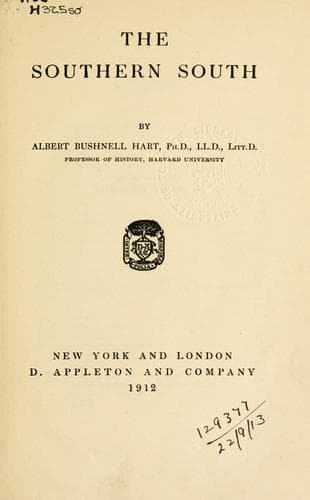
Southern States -- Social conditions; United States -- Race relations
So with the secondary schools, where the number of pupils has
astonishingly increased. In 1898 there were in the South 1,107 schools and
72,000 pupils; in 1906 there were 1,685 schools (Texas alone has 321),
5,100 teachers, and 118,000 pupils. A great change has come about in the
education of girls. Nearly half the teachers and nearly two thirds of the
pupils (70,000) in these schools are women, and that means that in
connection with the normal schools, in which there are over 7,000 women
students, the South is now training a body of teachers who are going, to
make a great change in the education of the next generation. The growth of
secondary schools means further that the South is putting an end to a
reproach of many years' standing--namely, that it could not adequately
prepare pupils for college.
It was a severe lesson when the trustees of the Carnegie retiring
allowance fund in 1906 laid down its principle that no grant would be made
to professors in any college which did not come up to the following
standard: "An institution to be ranked as a college must have at least six
professors giving their entire time to college and university work, a
course of four full years in liberal arts and sciences, and should require
for admission not less than the usual four years of academic or high
school preparation, or its equivalent, in addition to the preacademic or
grammar school studies." To the surprise of the Lower South, it was
discovered that only one institution, Tulane University, had insisted on
the condition of four years academic or high school preparation. Several
other organizations are waking the South up to the need of improvements,
such as the Association of Colleges and Preparatory Schools of the
Southern states, with nineteen colleges as members; a commission of the
Southern Methodist Church; the General Education Board of New York, with
its fund of $43,000,000; and the Southern Education Board.
Public-domain text, read in full here on John Shaqi.
Reviews
Reviews
No reviews yet
Be the first to share your thoughts on this work.
Elsewhere in the archive
Join the Discussion
Join the discussion
Sign in to leave a comment or review.
Sign InorCreate an account