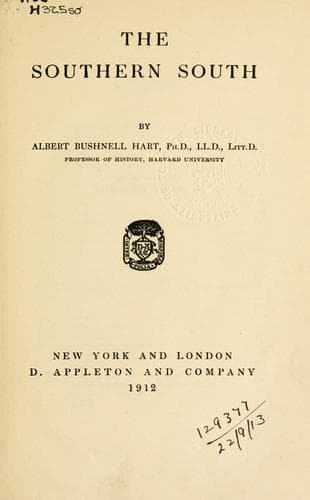
Southern States -- Social conditions; United States -- Race relations
In Cordova, S. C., in 1907, a business man who had visited a colored
school and spoken encouragingly to the pupils, felt compelled by public
sentiment to print an apology and a promise never to do anything so
dreadful again. This criticism comes not simply from demagogues like
Vardaman or weaklings like the Cordovan; intelligent planters will tell
you that they are opposed to negro education because it makes criminals;
and think their accusation proven by instances of forgeries by Negroes,
which of course they could not have committed had they been unable to
write. A superintendent of schools in a Southern city holds that even
grammar school education unsteadies the boys so that they leave home and
drift away; though he candidly acknowledges that it keeps the girls out of
trouble and provides a respectable calling as teachers to many negro
women.
Side by side with this feeling of disappointment or hostility, as the case
may be, is the conviction of most Southern people that enormous sacrifices
have been made for the negro schools. Thomas Dixon, Jr., with his
accustomed exactness and candor, wrote a few years ago: "We have spent
about $800,000,000 on Negro education since the War." These figures show a
poverty of imagination: it would be just as easy to write "eight thousand
millions" as "eight hundred." The estimate of the Bureau of Education is
that in the thirty-five years since 1870 about $155,000,000 has been spent
to support common schools for the negro race, which is about a fifth of
the amount spent on the white common schools in the same period, and not a
hundredth of the supposed present wealth of the South; in addition, heavy
expenditures are made out of the public treasury for secondary and higher
education in which the Negro has a slender share.
Another more specious complaint with regard to Negro education is that it
is an unreasonable burden on the Whites to make them pay for negro
education, and repeated attempts have been made to lay it down as a
principle that the Negroes shall have for their schools only what they
pay in taxes. Thus Governor Hoke Smith, of Georgia, says: "Is it not folly
to tax the people of Georgia for the purpose of conducting a plan of
education for the Negro which fails to recognize the difference between
the Negro and the white man? Negro education should have reference to the
Negro's future work, and especially in the rural districts it is
practicable to make that education really the training for farm labor. If
it is given this direction it will not be necessary to tax the white man's
property for the purpose. A distribution of the school fund according to
the taxes paid by each race would meet the requirements."
Public-domain text, read in full here on John Shaqi.
Reviews
Reviews
No reviews yet
Be the first to share your thoughts on this work.
Elsewhere in the archive
Join the Discussion
Join the discussion
Sign in to leave a comment or review.
Sign InorCreate an account