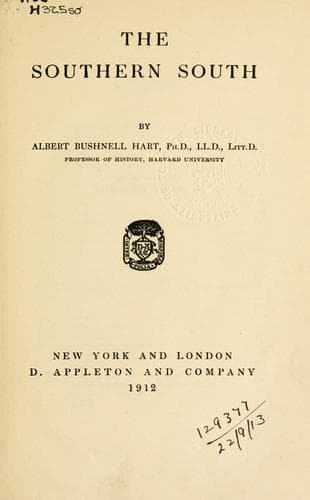
Southern States -- Social conditions; United States -- Race relations
In at least two states this idea has been to some extent carried out. In
Kentucky the state school fund is apportioned among the school children
without regard to race, but for local purposes the Negroes appear to be
thrown on their own payments. And in Maryland, under various statutes from
1865 to 1888, all the taxes collected from Negroes were devoted to negro
schools, the state adding a lump sum per annum.
This point of view involves a notion of the purpose of education and the
reasons for public schools so different from that which animates the North
that it is hard to deal with the question impartially. Massachusetts makes
the largest expenditure per capita of its population in the whole Union,
almost the largest expenditure per pupil, and certainly the largest
aggregate expenditure, except the more populous states of New York,
Pennsylvania, Illinois, and Ohio; Massachusetts spends on schools two
fifths as much every year as all the fifteen former slaveholding states
put together. In that state people think that school taxes are not money
spent but money saved: that they get back every cent of their $17,000,000
a year, several times over, in the increased efficiency of the people, in
the diminution of crime, in the addition to the happiness of life.
Schooling is insurance, schooling is the savings bank that can't break,
schooling is that sane kind of poor relief which prevents poverty. The
last thing which any Massachusetts community thinks of reducing is school
expenditure!
Furthermore, no principle is so ingrained in the Northern mind as that
since education is for the public benefit, every taxpayer must contribute
in proportion to his property. The rich corporations in New York or
Pittsburg, childless old couples, bachelor owners of great tracts of real
estate, wealthy bondholders educating their children in private schools,
never dream of disputing the school tax on the ground that they, as
individuals, make no demands on the school fund.
Public-domain text, read in full here on John Shaqi.
Reviews
Reviews
No reviews yet
Be the first to share your thoughts on this work.
Elsewhere in the archive
Join the Discussion
Join the discussion
Sign in to leave a comment or review.
Sign InorCreate an account