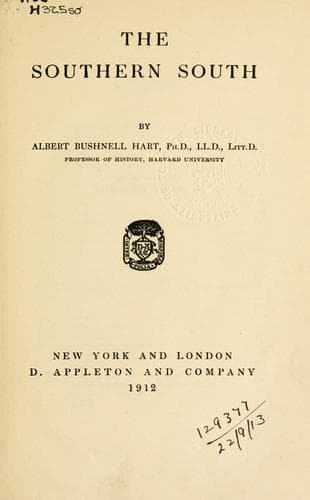
Southern States -- Social conditions; United States -- Race relations
Against both industrial and academic training many people in the South
feel a strong prejudice, because they believe that both tend to produce
leaders who may dangerously organize the fellows of their race. A favorite
form of slander has been to charge that the graduates of colleges furnish
the criminals, and practically the worst criminals, of the negro race.
Never was there a more senseless or a more persistent delusion. The total
number of male graduates of all the Southern colleges during the last
forty years is not above two thousand, besides perhaps five hundred
graduates of Northern colleges who have found their way into the South.
Many of those institutions have kept track of their graduates and are able
to assert that the cases of serious crime among them are remarkably few,
no more in proportion probably than among the graduates of Southern and
Northern colleges for Whites. The moral effect of the colleges among
Negroes is in the same direction as among Whites; the students include the
more determined of the race or the children of the more determined. The
negro college students are still only about one in one thousand of the
children and young people of the race. The total number of living
graduates of negro colleges or other institutions of college grade are not
one in two thousand of the Negroes in the South.
It is true that even that number find it hard to establish themselves in
professions or callings which can reward them for the sacrifices and
efforts of their education. The negro doctors and lawyers have almost no
white practice and not the best of negro practice, but there is an opening
for thousands of Negroes in the development of the education of their
people. The thousandth of the race in secondary schools and the two
thousandth or more in colleges are enough to prove that a large number of
individuals in the race are capable of and ought to have the advantages of
higher training.
The denial to the Negroes of public secondary education at the expense of
the state practically means that most of them will not have it at all. It
is denied on the ground that it unfits boys and girls for life--exactly
the argument which has been unsuccessfully brought against schools of that
grade in the Northern states. It is denied on the ground that beyond
twelve years of age most of the Negroes are stationary and cannot profit
by a secondary education, a conclusion which does not seem justified by
the experience of the few high schools and the numerous private and
benevolent schools. Still more serious, the denial of secondary education
means that the Negroes are deprived of the most obvious means of training
for teachers of their own race.
Public-domain text, read in full here on John Shaqi.
Reviews
Reviews
No reviews yet
Be the first to share your thoughts on this work.
Elsewhere in the archive
Join the Discussion
Join the discussion
Sign in to leave a comment or review.
Sign InorCreate an account