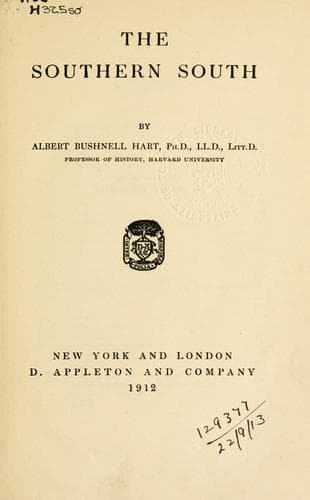
Southern States -- Social conditions; United States -- Race relations
white man might do, lynch him!
The real argument of competition works just the other way. The inferior
Negro is not likely to take the bread out of the mouth of the superior
white man; but, when relieved from the abnormal conditions of slavery and
of Reconstruction, he may still be able to hold his own in the struggle
for existence. Emancipation threw upon the Negro the responsibility for
his own keeping. The most that he can ask is a fair field without
artificial hindrances or limitations; and in such a field a race on the
average inferior may nevertheless find tasks in which it excels, and may
maintain its race life unimpaired. Kelly Miller says: "You were born with
a silver spoon in your mouth, I was born with an iron hoe in my hand"; and
the world needs the hoe hand just as much as the silversmith.
It would appear that for the uplift of the Negro something is needed on
the white side: remembrance of the foundations of American liberty, of the
workings of Christianity, of the economic truth that you are not made poor
because your neighbor gets on in the world. The curse of the South is that
its people do not more genuinely realize that the more active,
industrious, and thrifty a people become, the more their neighbors receive
out of the enlarged contribution to the community. If the Negroes were all
as intelligent as Roscoe Conkling Bruce, as forehanded as Benson of
Kowaliga, as lyric as Paul Dunbar, the Whites in the South might get rich
out of the trade of the Negro, and some of them see it so. For instance,
President Winston, of the Agricultural College of North Carolina: "Greater
industrial efficiency would prove an everlasting bond between the races in
the South. It is the real key to the problem. Let the Negro make himself
indispensable as a workman, and he may rely upon the friendship and
affection of the whites.... Public sentiment in the South still welcomes
the Negro to every field of labor that he is capable of performing. The
whole field of industry is open to him. The Southern whites are not
troubled by his efficiency but by his inefficiency." Meantime the really
industrious Negroes, of whom there are a couple of million or more, follow
the advice of Paul Dunbar:
I've a humble little motto
That is homely, though it's true,--
Keep a-pluggin' away.
It's a thing when I've an object
That I always try to do,--
Keep a-pluggin' away.
When you've rising storms to quell,
When opposing waters swell,
It will never fail to tell,--
Keep a-pluggin' away.
Public-domain text, read in full here on John Shaqi.
Reviews
Reviews
No reviews yet
Be the first to share your thoughts on this work.
Elsewhere in the archive
Join the Discussion
Join the discussion
Sign in to leave a comment or review.
Sign InorCreate an account