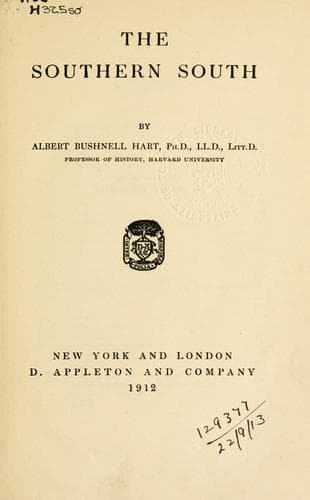
Southern States -- Social conditions; United States -- Race relations
The self-interest of the planter in the efficiency of his labor does not
necessarily lead him to see the highest interests either of the negro race
or of the South, under the present industrial system, which makes a
plantation a workshop rather than a farm. The ownership of rich cotton
lands only means wealth if you can find negro laborers and keep them at
work. One of the most powerful uplifting agencies in all agricultural
countries is the desire to own land, and one of the most frequent texts of
Booker Washington is that now is the time for the Negro to acquire land,
for it will never again be so cheap; but where is the land to be found?
Although ownership has almost completely changed since the Civil War, good
lands are aggregating more and more into large tracts. The white farmer
finds it difficult to hold his own against the capitalist and the
syndicate, and even the thrifty black is beset by special difficulties.
In the first place, the rural Negro has, unless by his saving from sawmill
and turpentine work, little opportunity to make money with which to buy a
farm, except from the farm itself: hence he buys on time, pays a heavy
interest charge, and is at every disadvantage. In the second place, few
planters are willing to break up their land into small tracts; to do so
takes away their livelihood, their only opportunity of making available
their knowledge of cotton planting and of dealing with cotton hands. Some
of them are absolutely opposed to letting the Negroes have land. Mr. Bell,
of Alabama, one of the largest landowners in the South, is credited with
saying that he "has no use for a Nigger that pays out." That is to say, he
prefer his hands to be unprogressive and in debt. Perhaps the South fails
to realize that the wealth of the Western, Middle, and New England states
comes from encouraging people to do the best they know how. The more
industrious the people are, the more business there is of every kind and
for everybody. The South would be happier and more prosperous if it could
accept the Western system of moderate-sized detached farms, on each of
which there is an intelligent owner or tenant.
The large number of negro landowners (though many of them perhaps are
mortgaged) and the evident prosperity of those communities in which the
greatest number of them hold their land, seems to show that landowning is
a motive that ought to be strongly set before them. The old notion of
Reconstruction times that the federal government ought to furnish "forty
acres and a mule" was not so far wrong; it would have been perfectly
possible for the nation to acquire land in large tracts, to subdivide it,
and give or sell it at nominal rates, so as to offer every thrifty Negro
the chance of proprietorship; but that opportunity, if it ever existed,
has long gone by, and the Negro must depend upon himself if he wishes to
buy land.
Public-domain text, read in full here on John Shaqi.
Reviews
Reviews
No reviews yet
Be the first to share your thoughts on this work.
Elsewhere in the archive
Join the Discussion
Join the discussion
Sign in to leave a comment or review.
Sign InorCreate an account