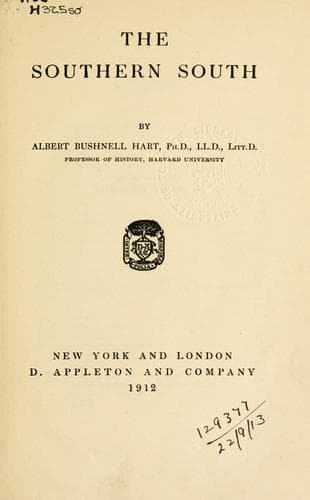
Southern States -- Social conditions; United States -- Race relations
Material progress is necessary for the Negro and equally for the Poor
White, not simply that he may be better clad and have better health, but
because it brings with it other influences which go to elevate mankind.
You cannot make good citizens and virtuous people out of a dirty, ill-fed
family in a one-room house; the remedy of intellectual and moral uplift is
as important as the material side. Thrift works both ways: the man who
buys good clothes for his children wants to send them to Sunday school;
the poor children in Sunday school beg their fathers to give them good
clothes. Such intellectual and moral agencies are at work, though here
again some white leaders object to them. For instance, John Temple Graves
asks: "Will the negro, with his increasing education and his surely and
steadily advancing worth and merit, be content to accept, in peace and
humility, anything less than his full and equal share in the government of
which he is a part?" Here is one of the stumbling blocks in the way of the
progress of the race.
For thrift and saving habits the South has always lacked one of the
approved aids; it has few savings banks, few ordinary banks which attract
the deposits of Negroes, and few steady investments in small
denominations. For this reason the proposed Postal Savings Banks would be
a boon to the South, and would help toward the purchase of land and other
property. The Negroes' own fraternal orders and stock companies furnish
some opportunities for savings. Regulation of drinking and gambling places
will also make saving likelier among the laborers. That difficulties and
conflicts of interest would rise between Whites and Negroes was foreseen
at the time of Reconstruction, and it was honestly supposed by the
thinking people of the North that the ballot would at the same time
protect the black against white aggression, and would educate him into the
sense of such responsibility that there would not be negro aggression.
Giving the negro suffrage, however, while at the same time through the
Reconstruction state constitutions disfranchising his former master,
brought about a condition of unstable equilibrium, and the strongest, best
organized, and most determined race of course prevailed. For some years
after the restoration of white supremacy in the Southern states, colored
men were still allowed to vote in districts like the Sea Islands of South
Carolina, and the Delta of Mississippi, where they were predominant, but
since 1885 there has not been any genuine negro suffrage in any state of
the South, in the sense that Negroes were assured that their votes could
be cast and would be counted even if they made a difference in the result.
The last remnant of a successful combination of negro voters with a
minority of the Whites was in the North Carolina election of 1896.
Public-domain text, read in full here on John Shaqi.
Reviews
Reviews
No reviews yet
Be the first to share your thoughts on this work.
Elsewhere in the archive
Join the Discussion
Join the discussion
Sign in to leave a comment or review.
Sign InorCreate an account